Published on: October 9, 2025

1. Purpose of the Maturity Assessment

We want to provide executives and leaders with a structured framework to:

  • Objectively measure the current state maturity of Organizational and MDM Capability across People, Process, and Technology based on industry best practices and our decades of enterprise experience.
  • Highlight misalignments and maturity gaps that may hinder transformation.
  • Build a shared baseline for a unified, business-driven MDM roadmap that IT can enable and scale.

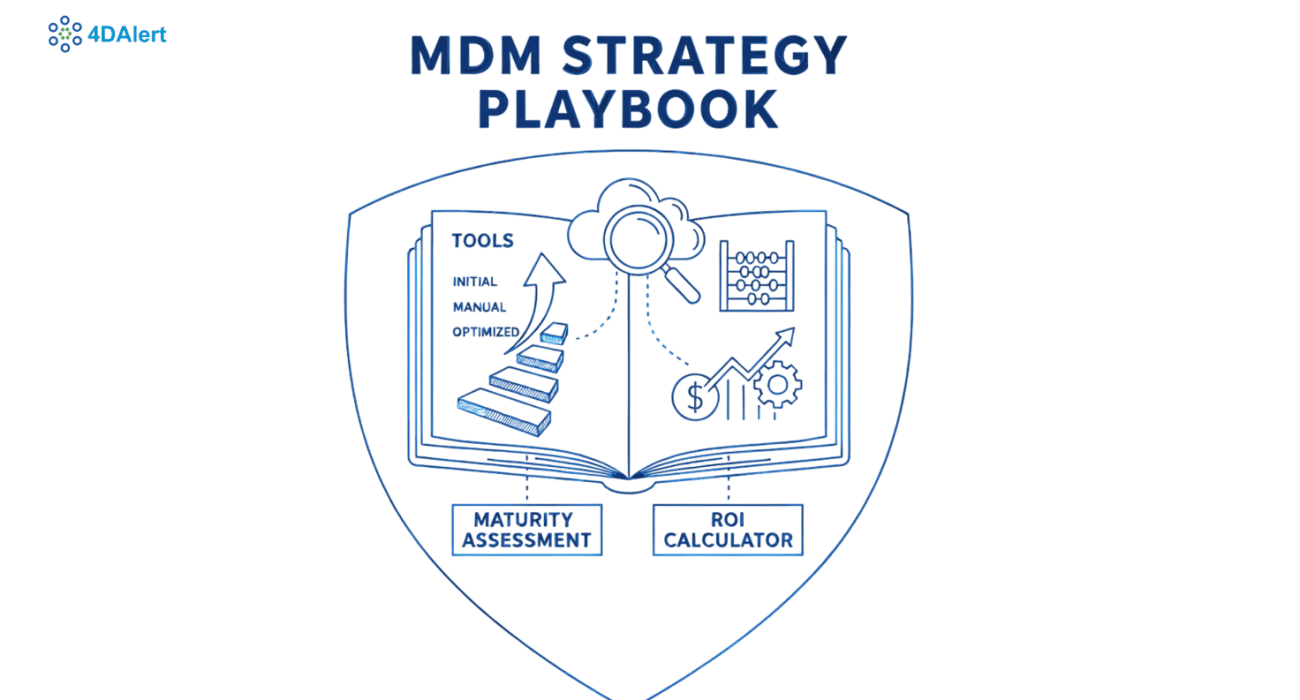
2. How to get the Strategy Playbook with the Maturity Assessment ?

3. How to use the Maturity Assessment?

Step 1 — Self-Assessment Questionnaire:
Leaders across Business and IT answer structured questions in 4 critical MDM domains and capabilities:

Scoring:
For each question, provide your self-assessment score and capture evidence/notes.

Self Assessment Score

0 : Absent or Ad-hoc

1 : Developing or Reactive

2 : Managed or Proactive

3 : Optimized


Optionally:
Apply weights by assigning % values to each of the four domains, the sum of all weights equal to 100%
(e.g., Strategy and Vision 25%, Data Governance Model 20%, Technology & Architecture 40%,
Operating Model and Culture 15%), depending on organizational priorities.


Step 2 — Dashboard Outputs:

Results are automatically summarized in a dashboard that highlights strengths, gaps,
and overall enterprise readiness.


Maturity Scorecard to show the average domain score and overall maturity score.
Radar chart (spider chart) to quickly visualize maturity distribution across domains.

4. Guidance on Interpreting Results

Individual question self-assessment scores are averaged to provide both a domain-level
and overall maturity score.


Average Score Maturity Levels:

  • Absent or Ad-hoc (0–1):
    Ad-hoc efforts, high fragmentation, limited governance.
  • Developing or Reactive (1–2):
    Some pilot implementations, emerging governance, and inconsistent adoption.
    Lack of MDM technology and capability maturity.
  • Managed or Proactive (2–3):
    Governance and processes are established and implemented.
    A modern MDM solution has been implemented for 1–2 domains, and adoption is measurable.
  • Optimized (3):
    Enterprise-wide adoption, MDM integrated into business processes across data domains,
    strong stewardship, continuous improvement, and a data-driven culture where MDM is a strategic enabler.


Business / IT Alignment:
Results should be interpreted not just as technical gaps, but as indicators of
organizational business and IT capability maturity.


Benchmarking:
Compare scores across domains — for example, strong technology but weak governance
indicates risks in realizing business value.

5. Leadership next steps

Executive Alignment:
Use the results to drive a joint conversation between Business and IT on shared ownership of master data.


Prioritization of Initiatives:
Focus on low-scoring, high-impact areas (e.g., governance, stewardship, or data quality monitoring).
Top 5 priority actions — e.g., establish data owners, deploy profiling & monitoring,
implement API for Customer 360, define survivorship rules, create executive KPI dashboard.


Now / Next / Later Roadmap Development:
Translate assessment findings into a 90-day Now plan, a 6-month Next plan,
and a 12-month Later plan with defined outcomes.

Quick Wins:
Launch visible initiatives (e.g., data quality dashboard, assigning business stewards)
to demonstrate value.
Long-Term Vision:

Position MDM as a data product platform that enables AI, analytics,
and digital
transformation.

4DAlert
Get the 4DAlert Strategy Playbook
Where intelligent monitoring meets strategic execution.
Assessment frameworks
Best-practice strategies
Implementation templates
Download Now →