
Solution / Master Data Management
Entity Relationship Modeling
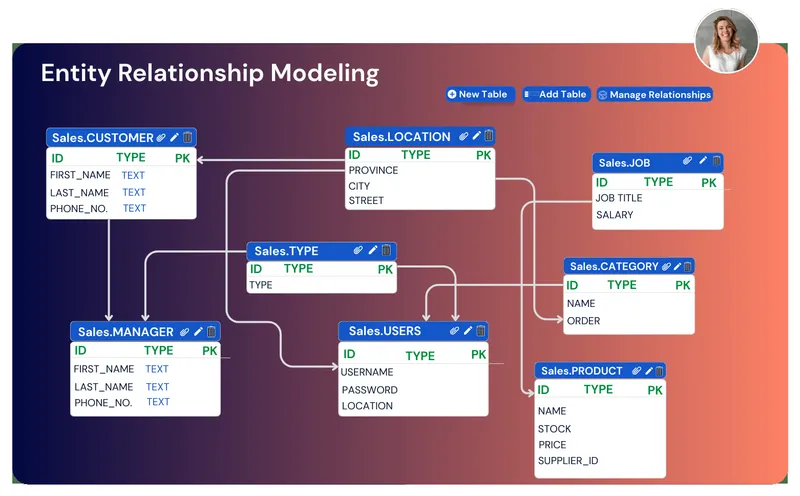
Entity Relationship Modeling is a framework for designing, visualizing, and managing data structures and relationships within enterprise databases. In modern data environments, databases are highly complex, with interconnected entities spread across multiple systems. Without clear visibility into how data is structured and related, organizations face challenges in data design, integration, and governance. 4DAlert addresses these challenges by automating the creation and management of Entity-Relationship (ER) diagrams — giving a clear, real-time view of database structures and relationships to ensure consistency, accuracy, and optimized data architecture.
Overview
What is Entity Relationship Modeling?
Entity Relationship Modeling is the process of defining data entities, their attributes, and the relationships between them to represent real-world business structures.
It enables organizations to:
Typically represented using ER diagrams, this approach helps teams model how entities — such as customers, products, or transactions — interact within a system.
- Visualize data structures and relationships clearly
- Design efficient and scalable database schemas
- Understand dependencies between entities
- Improve data consistency and system integration
Key Features
What's inside
Value & Outcomes
Clear Database Understanding
Provide a complete and intuitive view of data structures and relationships, improving planning and decision-making.
Early Issue Detection
Identify design flaws, inconsistencies, and performance risks early in the development lifecycle.
Improved Team Collaboration
Establish a shared visual reference that aligns developers, data engineers, and business stakeholders.
Simplified Database Management
Keep ER diagrams automatically updated, reducing manual effort and ensuring consistency over time.
Use Cases
Real-world applications of Entity Relationship Modeling.
Database Design & Architecture
Design scalable and optimized database schemas aligned with business requirements.
System Integration Planning
Understand relationships between entities across systems to support seamless integration.
Data Governance & Documentation
Maintain clear documentation of data structures and relationships for governance and compliance.
Impact Analysis
Assess how schema or structural changes impact related entities and downstream systems.
Legacy System Understanding
Visualize and analyze existing databases to simplify modernization or migration efforts.
Team Collaboration and Onboarding
Visual entity maps enable quick comprehension of data structures by developers and cross-functional teams.
Why Choose 4DAlert
Automated ER Modeling
Generate and maintain ER diagrams automatically without manual effort.
Real-Time Schema Reflection
Ensure diagrams always represent the latest database structure and relationships.
Simplified Visualization
Break down complex data relationships into clear, intuitive diagrams.
Integrated DataOps Ecosystem
Seamlessly align with CI/CD, schema management, and data quality workflows.
Ready to see Entity Relationship Modeling in action?
Talk to our team for a personalized walkthrough of how 4DAlert fits into your existing data stack.
FAQ
Frequently Asked Questions
What is Entity Relationship Modeling?
Entity Relationship Modeling is the process of defining and visualizing entities, attributes, and relationships within a database to represent how business data is structured.
What is an ER diagram?
An Entity Relationship (ER) diagram is a visual representation of entities and the relationships between them within a database.
Can 4DAlert automatically generate ER diagrams?
Yes. 4DAlert automatically generates ER diagrams based on the current database structure and updates them as schema changes occur.
How does Entity Relationship Modeling help database design?
It helps teams understand data structures and dependencies, design scalable database schemas, identify relationships, and improve data consistency.
Can 4DAlert visualize complex database relationships?
Yes. 4DAlert provides visual representations of complex relationships between tables, entities, and schemas.