
Solution / Data Quality
Automated Data Reconciliation
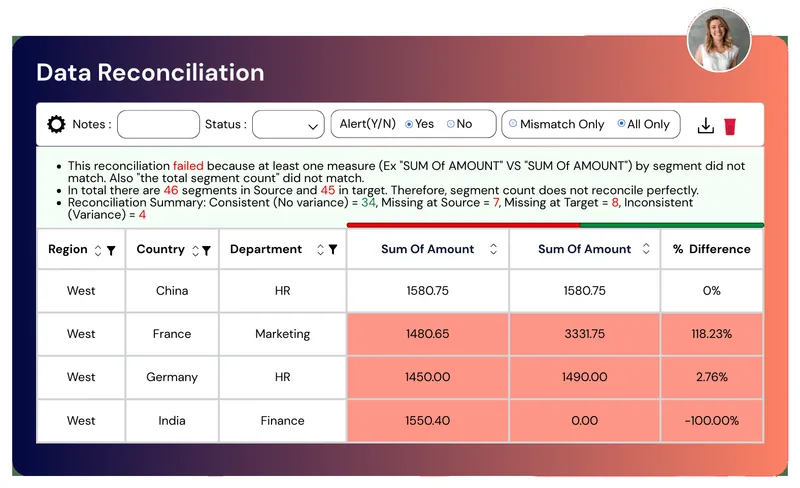
Automated Data Reconciliation is the process of validating and ensuring consistency of data across distributed enterprise systems by automatically identifying discrepancies, mismatches, and anomalies. In contemporary data ecosystems, data is distributed in data warehouses, transactional systems, APIs and third party platforms. This fragmentation usually causes discrepancies, lost records and transformational errors, thus manual reconciliation is inefficient and subject to error. To overcome these issues, 4DAlert turns the process of reconciliation into an intelligent, scalable, and real-time system, where datasets are continuously compared, discrepancies are detected, and actionable insights are generated to maintain the accuracy and reliability of the data.
Overview
What is Automated Data Reconciliation?
Automated Data Reconciliation refers to the process of comparing data in more than two systems in search of inconsistencies, missing values, duplicates and transformation errors.
It helps organizations to:
This is more than a row-level check as it includes schema validation, field-level checks, transformation logic checks, and AI-based anomaly detection.
- Make sure that the systems are consistent
- Test data pipelines ETL/ELT
- Identify abnormalities and violations in real time
- Ensure reporting and analytics accuracy
Key Features
What's inside
Value & Outcomes
Complete Data Consistency
Ensure alignment between source and target systems, eliminating discrepancies between datasets.
Early Error Detection
Detect anomalies during ingestion or transformations in time to prevent effects on the downstream systems.
Operational Efficiency
Reconcile data in real-time, reducing the effort in troubleshooting data issues from days to minutes.
Enhanced Data Trust
Leverage trusted data and create trust in decision-making and insights generation.
Use Cases
Real-world applications of Automated Data Reconciliation.
Data Pipeline Validation
Ensure accuracy and completeness at every stage of ETL/ELT pipelines.
Financial Data Reconciliation
Validate financial postings, account balances and finance reports across multiple financial systems.
Data Migration / System Integration
Simplify data migration by automating data validation and consistency checks across systems.
Data Warehouse Consistency
Maintain consistency between data warehouses, lakehouses, and the source systems.
Regulatory Reporting
Provide accuracy and conformity in reporting to meet regulatory standards.
Master Data Synchronization
Synchronize master data between applications, domains, and business units.
Why Choose 4DAlert
Fully Automated Reconciliation
Automate system-to-system data validation and reconciliation in real-time without any manual intervention.
AI-Powered Validation
Identify anomalies, data discrepancies and outliers using advanced AI/ML models.
Seamless Integration
API-based connection to existing databases, pipelines and cloud platforms.
Enterprise-Grade Security
Ensure secure data processing by role-based access and governance controls.
Ready to see Automated Data Reconciliation in action?
Talk to our team for a personalized walkthrough of how 4DAlert fits into your existing data stack.
FAQ
Frequently Asked Questions
How does automated data reconciliation work?
Automated data reconciliation connects to your source and target systems through APIs and compares the data after each load. AI/ML models flag mismatches, and 4DAlert alerts your team by email, text or Slack.
What can automated data reconciliation detect?
It detects data discrepancies, missing values, duplicates, transformation errors and anomalies between systems, before they reach your reports and dashboards.
Can you reconcile data without access to the source system?
Yes. When connecting to the source isn't possible, 4DAlert reconciles new data against historical trends within the target to spot anomalies.
What is the difference between data reconciliation and data quality?
Data reconciliation checks that data matches across systems. Data quality management checks that the data itself is accurate, complete and fresh.