
Solution / AI
Ask4D GenAI Assistant
Ask4D GenAI Assistant is a conversational AI layer that enables users to interact with enterprise data and metadata using natural language. In modern data environments, accessing insights often requires SQL expertise, deep knowledge of schemas, and understanding of complex data pipelines. This creates bottlenecks, slows decision-making, and limits data accessibility across business teams. 4DAlert addresses these challenges with Ask4D — a GenAI-powered assistant that allows users to query, explore, and understand data through simple conversations, eliminating the need for technical expertise and accelerating time-to-insight.
Overview
What is Ask4D GenAI Assistant?
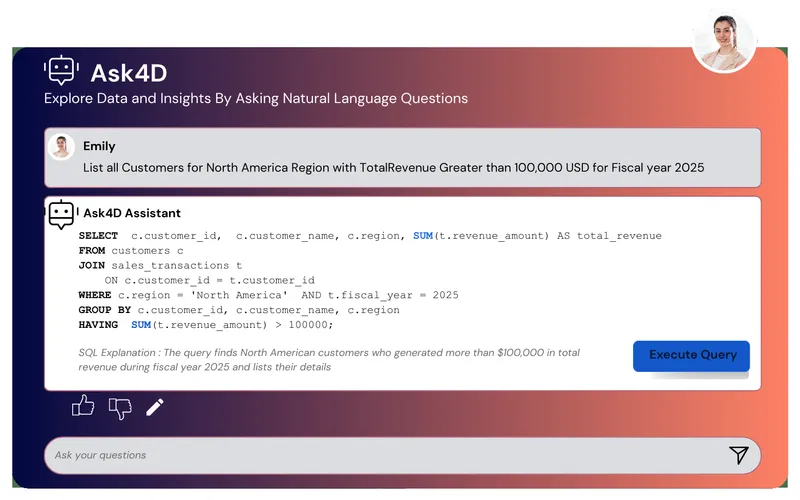
Ask4D is a Generative AI-powered assistant designed to help users retrieve insights, understand data structures, and analyze datasets using natural language queries.
It enables organizations to:
The assistant uses LLM-driven contextual understanding to interpret user intent, ask clarifying questions, and deliver accurate, explainable responses.
- Query data using plain English instead of SQL
- Generate and explain SQL queries automatically
- Understand metadata, lineage, and relationships
- Explore data quality and reconciliation insights
Key Features
What's inside
Value & Outcomes
Faster Time-to-Insight
Reduce time required to access insights by up to 75% through natural language querying.
Reduced Dependency on Technical Teams
Enable business users to access and analyze data without relying on data engineers or analysts.
Accelerated Onboarding
Reduce training time by up to 50% with an intuitive, conversational interface.
Better Decision-Making
Provide instant, explainable insights that improve speed and confidence in decision-making.
Use Cases
Real-world applications of Ask4D GenAI Assistant.
Business User Data Exploration
Allow non-technical users to explore datasets and retrieve insights without SQL knowledge.
SQL Query Assistance
Help analysts generate, validate, and understand SQL queries quickly.
Data Quality Investigation
Identify missing values, anomalies, and inconsistencies through conversational queries.
Data Reconciliation Analysis
Understand mismatches between systems and trace root causes efficiently.
Metadata Discovery
Explore schema, relationships, and lineage without manual documentation review.
Stakeholder & Executive Reporting
Enable business leaders to query performance, trends, and KPIs in plain language and receive real-time insights without relying on analyst teams.
Why Choose 4DAlert
Conversational Data Access
Interact with complex data systems using simple, intuitive conversations.
AI-Powered Context Understanding
Leverage LLM-based intelligence to interpret intent and deliver accurate responses.
Integrated Data Ecosystem
Seamlessly connects with MDM, Automated Data Quality, Data Reconciliation, and Data Observability workflows.
Enterprise-Ready Scalability
Built for large-scale, distributed, and complex enterprise data environments.
Ready to see Ask4D GenAI Assistant in action?
Talk to our team for a personalized walkthrough of how 4DAlert fits into your existing data stack.
FAQ
Frequently Asked Questions
What is Ask4D GenAI Assistant?
Ask4D is a Generative AI-powered assistant that allows users to interact with enterprise data and metadata using natural language.
Do users need SQL knowledge to use Ask4D?
No. Users can ask questions in plain English, while Ask4D can generate and explain SQL queries automatically.
Can Ask4D generate SQL queries from natural language?
Yes. Ask4D can interpret natural-language questions and generate SQL statements that users can review and use.
Can Ask4D explain SQL queries?
Yes. Ask4D can explain SQL queries and underlying data logic in simpler terms, supporting both learning and query validation.
Can Ask4D help users understand data lineage and metadata?
Yes. Ask4D can help users understand table definitions, column relationships, metadata, lineage, and business context.