

Table of Contents
Author

Prachi Sharma
Solution Analyst, 4DAlert
Despite widespread adoption of cloud-based enterprise systems like Salesforce CRM, SAP S/4HANA Cloud, Microsoft Dynamics 365, and Snowflake data warehouses, organizations continue to struggle with fundamental Master Data Management (MDM) issues. The core problem isn’t the individual platforms, it’s the architectural and Master Data Management challenges that emerge when these systems operate in isolation.
The Problem: Your Systems Don’t Talk to Each Other
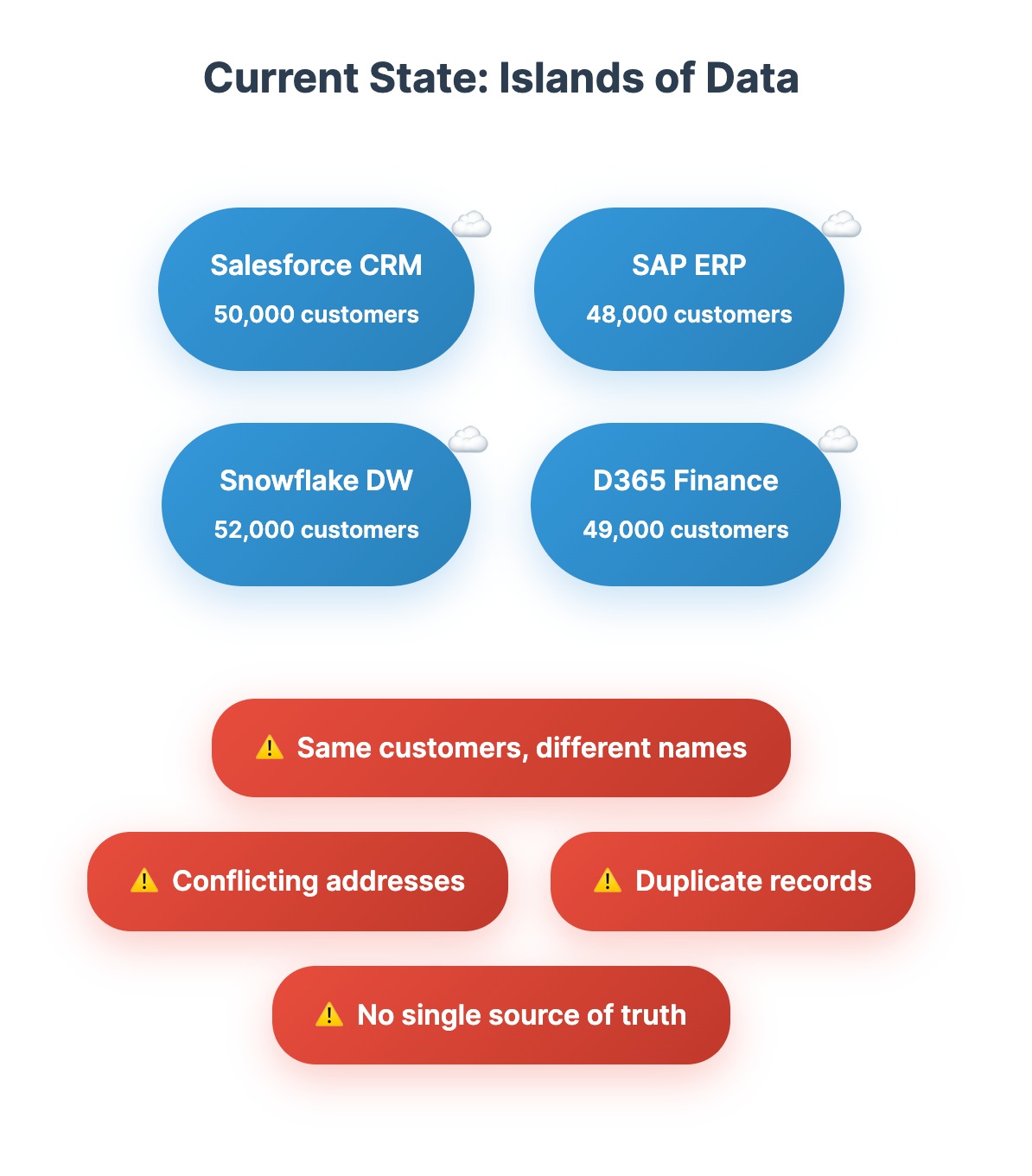
Here’s what’s really happening: each system stores customer data differently, creating a fragmented view of your business. Marketing thinks you have 50,000 customers, Finance says 48,000, and Analytics reports 52,000. The reality? You probably have around 15,000 unique customers buried under thousands of duplicates. This is where robust Master Data Management practices are critical.
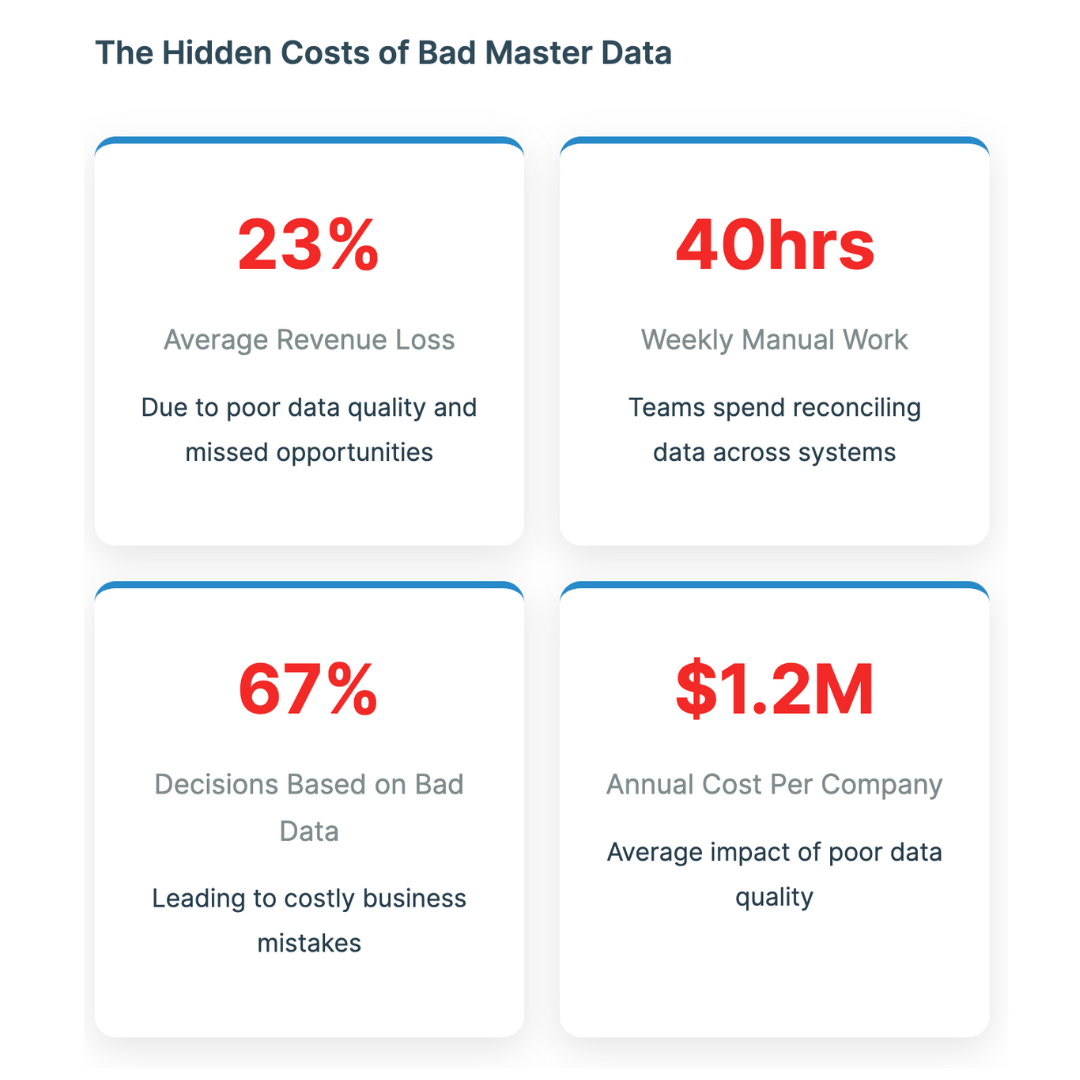
The Seven Root Causes of Master Data Chaos
1. Semantic Differences: When Systems Speak Different Languages
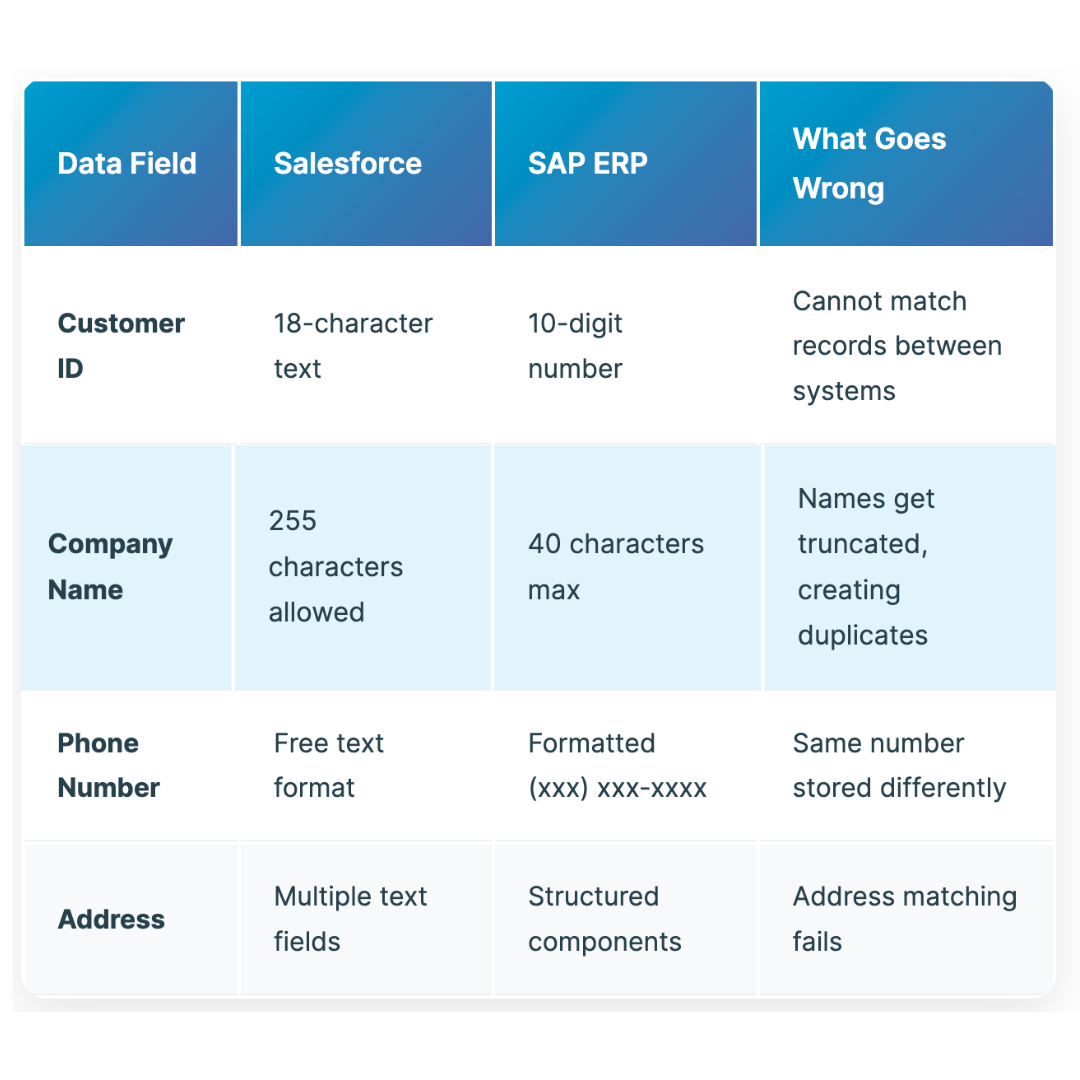
Every system has its own way of defining business entities. What’s an “Account” in Salesforce might be a “Customer” in your ERP, a “Company” in marketing tools, or a “Business Partner” in procurement. These aren’t just naming differences, they reflect different data models, field formats, and validation rules.
2. The Duplicate Detection Challenge
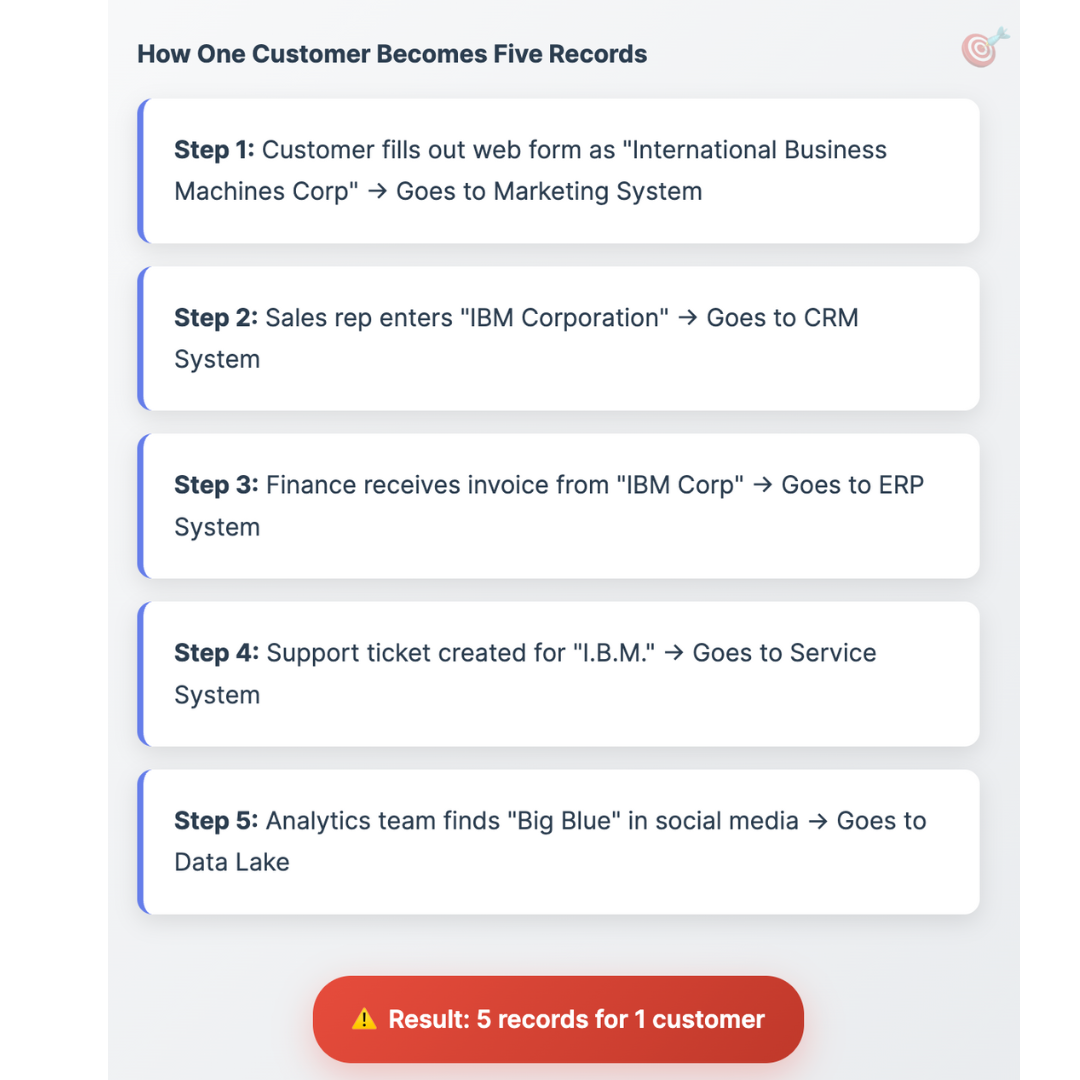
Identifying duplicate records is one of the most complex challenges in MDM and Master Data Management systems. Traditional methods rely on exact matches or simple variations, but real-world data is often inconsistent and evolving.
3. Integration Challenges
Cloud systems promise easy integration through APIs, but the reality is more complex. Each system has its own API design, rate limits, authentication methods, and data formats. What seems like a simple data synchronization task becomes a complex engineering project. Each has its own:
⦿ API limits: Salesforce allows 15,000-5,000,000 API calls per day
⦿ Data formats: JSON, XML, CSV, proprietary formats
⦿ Update frequencies: Real-time, batch, or scheduled
⦿ Security requirements: Different authentication methods
4. Scale Amplifies Every Problem
As your business grows, master data problems don’t just get bigger, they get exponentially worse. The number of possible duplicate combinations grows quadratically with the number of records. If you have 1,000 customers, you have roughly 500,000 possible duplicate pairs to check. If you have 10,000 customers, you have roughly 50 million possible pairs. In short,
⦿ More customers = more duplicates
⦿ More products = more classification conflicts
⦿ More vendors = more naming inconsistencies
⦿ More systems = more integration points
5. Governance Gaps and Data Quality Blind Spots
Data governance is often overlooked in Master Data Management frameworks. When no one clearly owns the data, quality suffers while teams update records in isolation, create duplicates, and overlook inconsistencies.
Different functions prioritize speed over accuracy: Sales wants to close deals, Marketing wants leads, and Support wants quick resolutions. Data quality becomes an afterthought.
Without clear policies, ownership, or accountability, records become outdated and fragmented. Over time, teams lose trust in shared data and resort to unofficial sources making things even worse.
6. Legacy System Complexity
Despite the move to cloud computing, most organizations still have legacy systems that can’t be easily replaced. These systems often have older data models, limited integration capabilities, and rigid data structures that don’t align with modern cloud systems.
7. The Measurement Problem: You Can’t Improve What You Don’t Measure
Many organizations struggle to measure data quality effectively. They might have a sense that their data has problems, but they don’t have specific metrics or regular monitoring processes to identify and track Master Data Management quality issues.
The measurement challenge is compounded by the fact that data quality has many dimensions like accuracy, completeness, consistency, timeliness, and validity. Different stakeholders might care about different aspects of data quality, making it difficult to establish organization-wide metrics and goals.
How 4DAlert Solves These Root Causes:
4DAlert AI-powered MDM addresses the most common challenges organizations face with fragmented and inconsistent data. Instead of relying on manual fixes, it automates the process end-to-end—bringing scalability, accuracy, and compliance into everyday operations.
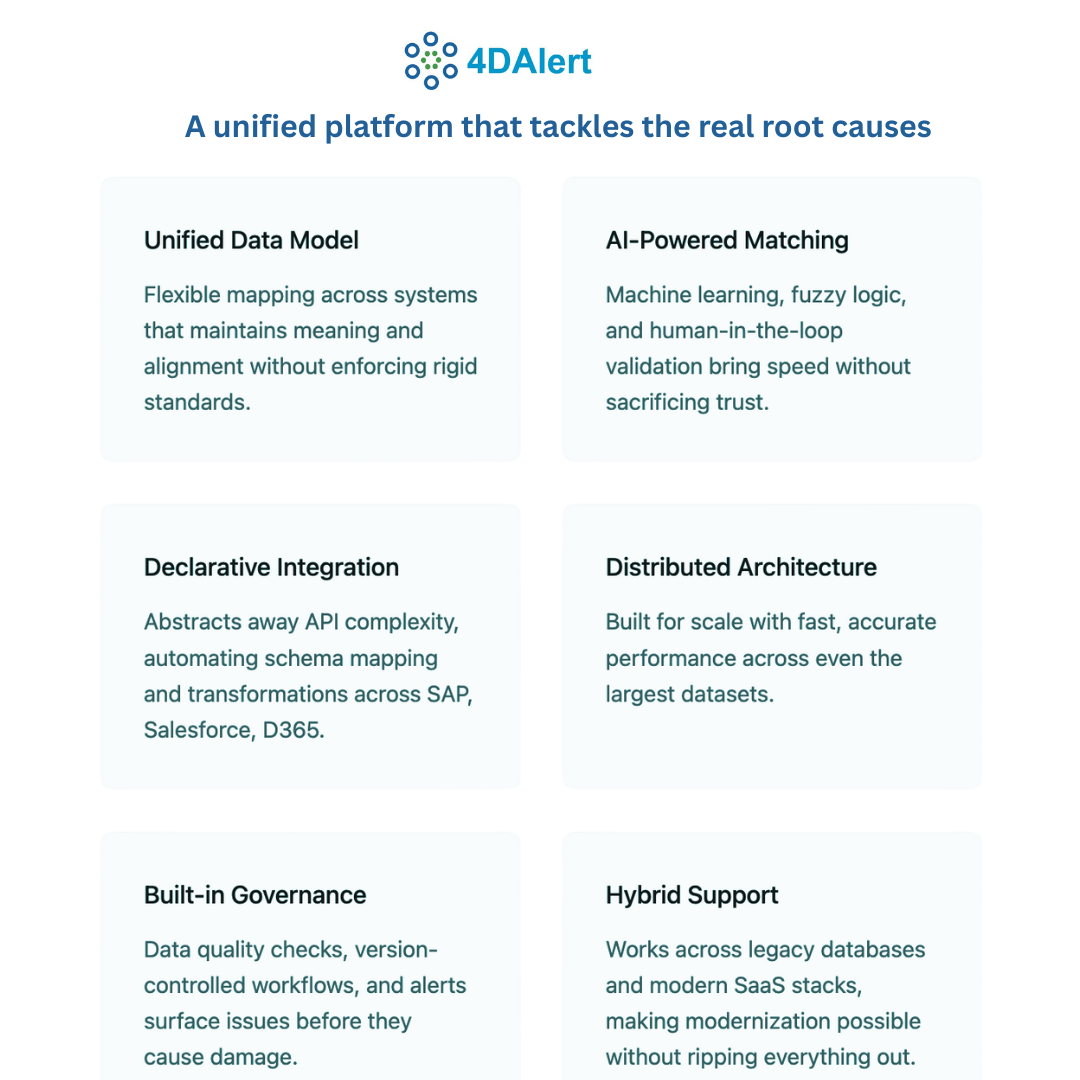
1. Advanced Duplicate Detection and Resolution Engine
Our proprietary duplicate detection engine goes beyond simple string matching, using machine learning algorithms trained on industry-specific data patterns to identify duplicates with exceptional accuracy.
Core Features:
⦿ Multi-Dimensional Matching: Combines fuzzy string matching, phonetic algorithms, and semantic similarity to identify duplicates across multiple data dimensions
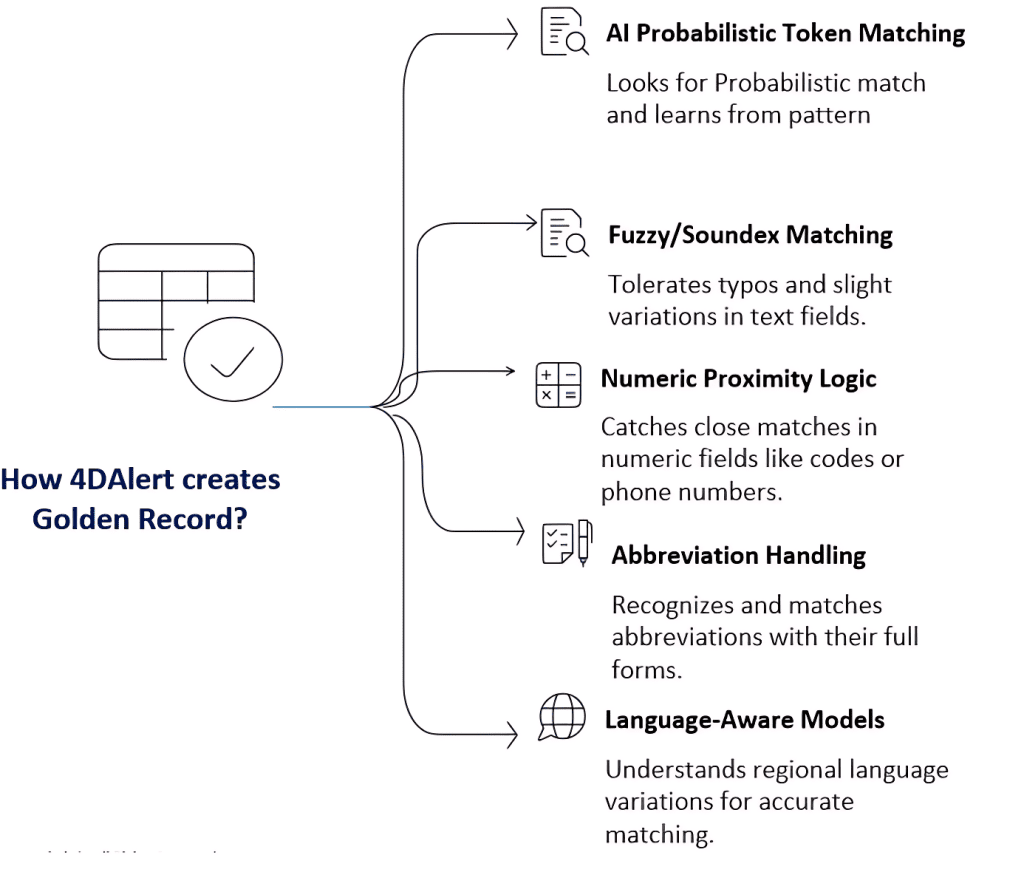
⦿ Contextual Duplicate Detection: Understands business context to distinguish between legitimate similar records and true duplicates
⦿ Confidence Scoring: Provides probability scores for potential matches, allowing teams to prioritize high-confidence duplicates
⦿ Automated Resolution Workflows: Smart merge algorithms that preserve the most complete and recent data while maintaining full audit trails
⦿ Industry-Specific Models: Pre-trained models for different industries that understand domain-specific duplicate patterns
⦿ Real-Time Duplicate Prevention: Catches potential duplicates at the point of data entry before they pollute your systems
Performance Metrics : 95%+ accuracy in duplicate identification with 80% reduction in manual review time.
2. Unified Master Data Hub: Single Source of Truth
4DAlert creates a centralized master data hub that serves as the authoritative source for all critical business entities while maintaining real-time synchronization with operational systems.
Master Data Hub Features:
⦿ Golden Record Creation: Intelligent algorithms that create the most complete and accurate version of each entity from multiple source systems
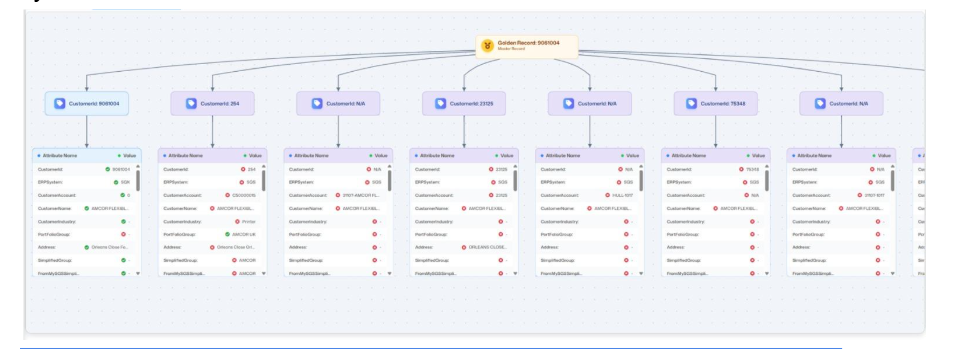
⦿ Hierarchy Management: Manages complex organizational, product, and geographic hierarchies with change tracking
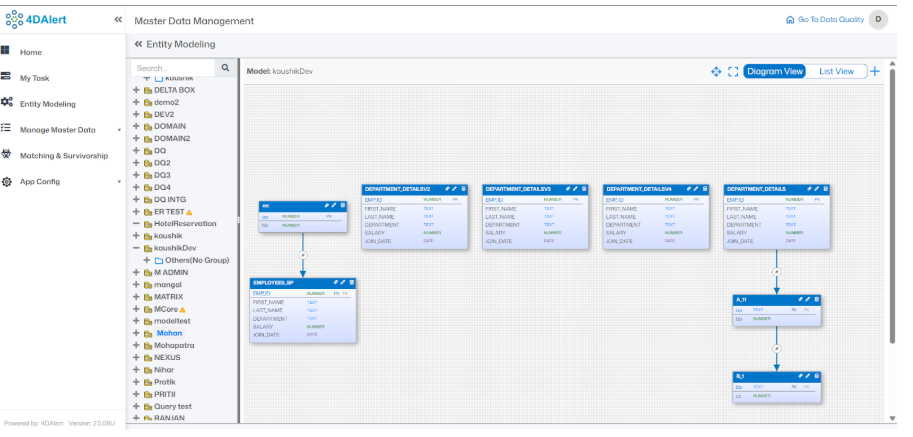
⦿ Reference Data Management: Centralized management of lookup tables, code sets, and reference data used across systems
⦿ Data Survivorship Rules: Configurable rules that determine which source system’s data takes precedence for different attributes
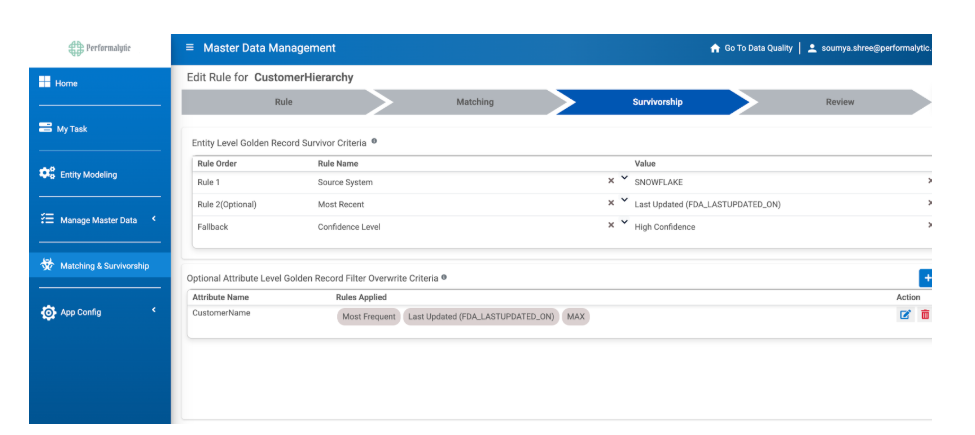
⦿ Data Distribution: Intelligent distribution of master data updates to subscribing systems based on their specific needs
⦿ Conflict Resolution: Automated and manual processes for resolving data conflicts between systems
Hub Benefits: Provides 360-degree view of customers, products, and vendors while reducing data inconsistencies by 95%.
3. Cross-System Validation and Data Reconciliation
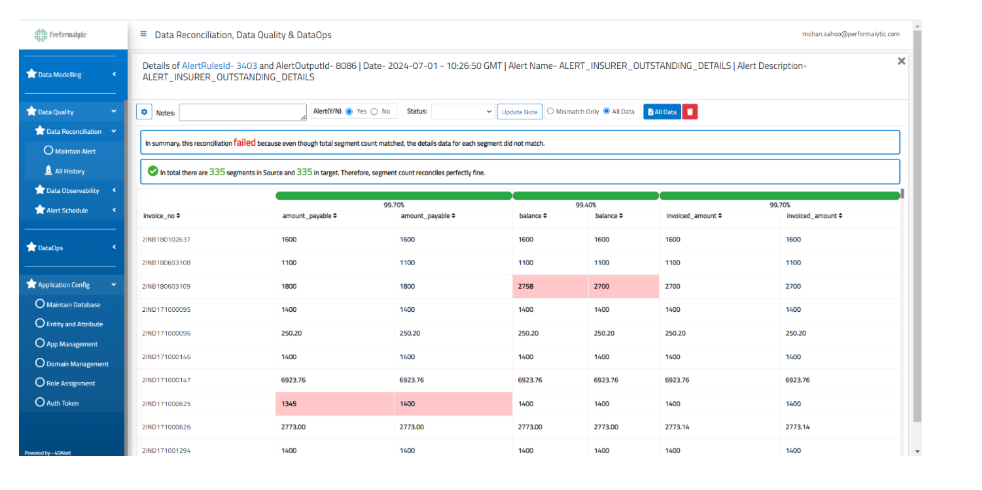
Validate and reconcile data across multiple enterprise systems to ensure accuracy, completeness, and consistency. 4DAlert automates field- and record-level comparisons between ERPs, CRMs, and data warehouses, using intelligent matching rules and configurable thresholds to detect and resolve mismatches efficiently. This continuous validation process keeps data synchronized across all connected platforms and ensures that every system operates from a single, trusted dataset.
Key Benefits:
⦿ End-to-End Accuracy: Automatically identifies and corrects mismatched or missing records across systems.
⦿ Faster Resolution: Intelligent rules and auto-alerts enable quick investigation and issue resolution.
⦿ Operational Confidence: Ensures all connected systems reflect accurate, up-to-date data.
⦿ Scalability: Handles high-volume, cross-platform validations seamlessly.
Outcome: Enterprises gain unified, consistent data across all systems — supporting reliable analytics, reporting, and decision-making.
4. Automatic Raw Data Feed into MDM
Ingest raw data from multiple enterprise sources automatically using configurable connectors and pipelines. 4DAlert continuously captures updates from ERPs, CRMs, and external data hubs — eliminating manual imports and ensuring the MDM repository always reflects the latest state of enterprise data.
Key Benefits:
⦿ Continuous Ingestion: Automatically syncs new or updated records from connected systems.
⦿ Reduced Manual Effort: Eliminates repetitive file uploads or manual data pulls.
⦿ Data Freshness: Keeps master records current and aligned across all sources.
⦿ Scalability: Handles high-volume feeds without latency or loss.
Outcome: Your MDM becomes a live, always-up-to-date source of truth ready for governance, enrichment, and distribution.
5. Enable Secure and Seamless distribution of Golden Data
Outbound APIs provide real-time, standardized access to mastered data — ensuring every consuming application (ERP, CRM, Analytics, etc.) operates from a single, trusted version of truth.
Key Benefits:
⦿ Real-Time Sync: Instantly propagate master data updates across all systems.
⦿ Interoperability: Standardized API endpoints simplify integration.
⦿ Data Integrity: Deliver only validated, governed, and version-controlled records.
⦿ Faster Adoption: Reduce manual data exports or batch loads.
Outcome: Consistent, high-quality data delivered wherever it’s needed — accelerating analytics, transactions, and decision-making across the enterprise.
6. Ask4D: Your Conversational AI Assistant for Master Data
Even with the best MDM platforms in place, data users still hit bottlenecks. Teams want quick answers like “How many unique vendors?” … That’s where Ask4D, 4DAlert’s built-in AI assistant, steps in to enhance Master Data Management usability. What changed in the GLDataLatest table? but not everyone knows SQL or how to navigate complex tables.
That’s where Ask4D, 4DAlert’s built-in AI assistant, steps in.
Ask4D lets you query your data in plain English. No technical skill required. Just ask your question, and it responds instantly—with the data and the reasoning behind it.
Example:
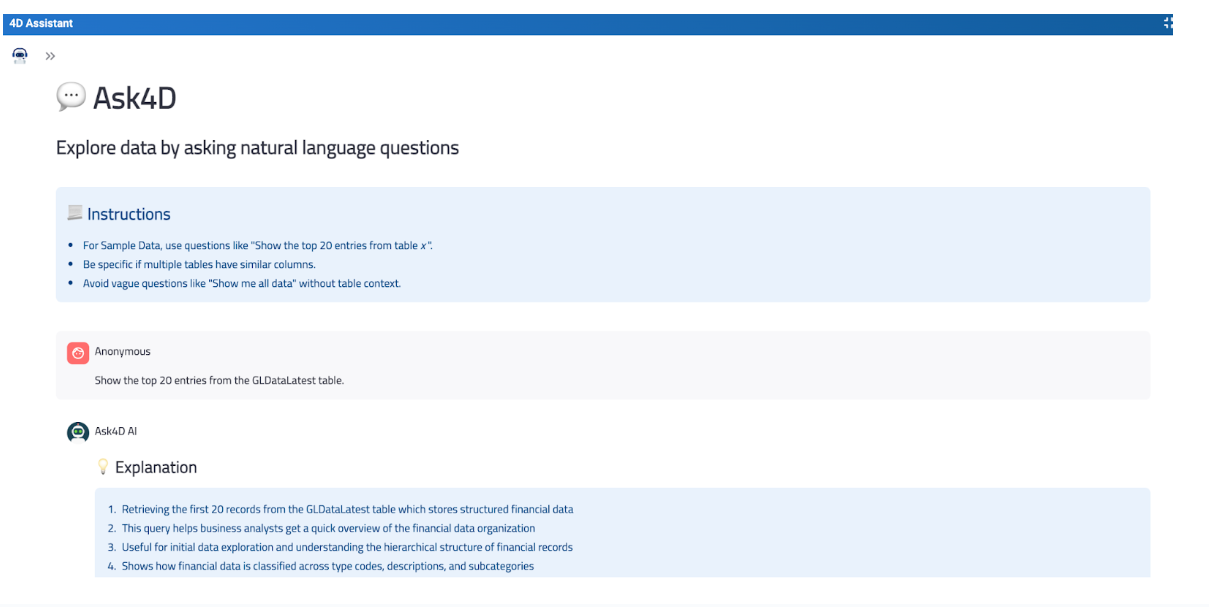
You ask: “Show the top 20 entries from the GLDataLatest table.”
Ask4D replies with the results and explains:
“This query retrieves the first 20 records from the GLDataLatest table.”
It’s not just about output, it’s about helping users understand their data. Whether you’re in Finance, Operations, or QA, Ask4D turns your questions into accurate, explainable answers.
Key Capabilities of Ask4D:
Natural Language Interface
Just type your query as you think it—no need to write SQL or know the backend table names.
Contextual Understanding
Knows how your systems are connected. If you ask for “customer count,” it figures out which systems and definitions apply.
Query Guidance
If something’s off like an ambiguous table name it suggests corrections or asks for clarification before proceeding.
Explains the Logic
Every response includes a plain-English explanation so non-technical users understand what the query is doing.
Final Thoughts
Master Data Management in the cloud era requires more than point-to-point integrations—it demands architectural alignment, semantic consistency, and scalable data quality controls. 4DAlert tackles these challenges with an AI-driven matching engine, a centralized hub, and a unified semantic layer. With Ask4D, it also enables natural language access to governed, reliable data bridging the gap between technical complexity and business usability.
The result: clean, connected, and context-aware Master Data Management that scales with your enterprise.