
Data Observability
Implementing Data Quality & Observability in Real-Time Data Warehouses
TL;DR
Key takeaways
- Fast ingestion (CDC, event streaming, sub-ten-second Snowpipe Streaming) does not guarantee reliable data — pipelines can report success while delivering duplicates, nulls, or schema drift
- Nine recurring failure modes break reliability in continuously flowing data, from stale and inconsistent data to duplicate records and limited root-cause visibility
- Three real-world scenarios (e-commerce NULL prices, retail inventory duplicates, banking transaction delays) show how infrastructure can work perfectly while the data is still wrong
- Six common industry approaches — rule validation, pipeline monitoring, observability platforms, automated testing, AI anomaly detection, root-cause analysis — still leave gaps like disconnected tools, static thresholds and alert fatigue
- 4DAlert connects rule-based data quality, a historical Data Quality Trend Matrix, and the Ask4D assistant under one Data Quality Index, with automated root-cause analysis and AI-generated, role-permissioned fix queries
Introduction: Speed Only Matters When the Data Can Be Trusted
Modern data architectures are designed to move information with minimal delay. Technologies such as Change Data Capture (CDC), event streaming, and cloud-native ingestion allow organizations to capture operational changes and make them available for analytics almost immediately. For example, Snowflake's Snowpipe Streaming supports ingest-to-query latency as low as five seconds, depending on workload and configuration. However, faster data movement does not guarantee reliable data. A pipeline may complete successfully while delivering duplicates, missing values, inconsistencies, or unexpected changes.
This creates a growing challenge for organizations relying on real-time analytics and AI-driven applications. A duplicate transaction can distort revenue figures, an unexpected schema change can disrupt downstream processing, and incomplete inventory data can affect business decisions. In continuously updated environments, such issues can spread before traditional validation processes identify them.
The challenge is no longer just moving data faster. Organizations need to understand how data changes, detect anomalies, investigate root causes, and address issues before they affect downstream systems. This calls for continuous data quality validation, historical observability, and Agentic AI-assisted investigation to build a reliable data foundation for analytics and AI applications.
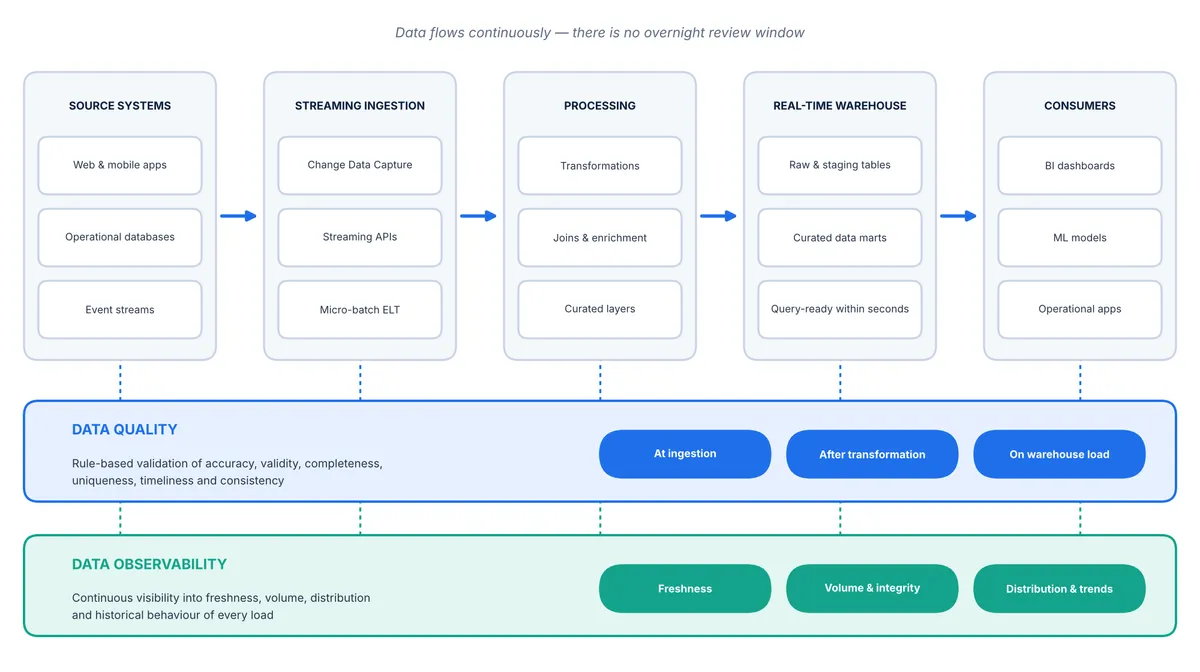
Data reliability requires more than validating records. Data quality ensures that data meets business and structural expectations, while Data observability continuously monitors data and pipeline behavior to detect unusual patterns, changes, and potential issues. Together, they provide the foundation for Agentic AI to investigate anomalies and help teams address data reliability issues. Figure 1 shows where each sits in a typical real-time architecture.
Where Reliability Breaks Down in Continuously Flowing Data
Streaming removes the batch boundary that once made problems easy to see. Nine failure modes recur:
- Stale data - Delayed ingestion or processing leaves dashboards showing an outdated picture while appearing live.
- Incomplete data - Missing records, unfinished transactions and partial loads quietly understate downstream calculations.
- Inaccurate values - A pipeline can execute successfully while loading nulls, wrong values or impossible numbers.
- Inconsistent data - Different source systems can disagree about the same customer, product or amount.
- Unexpected volume changes - A sudden drop may signal broken ingestion, while a spike may be genuine demand or a replayed feed. Without history, the two look alike.
- Duplicate records - Retries and repeated delivery can insert the same transaction twice. Exactly-once options exist, but BigQuery's documentation notes that its default stream does not provide that guarantee.
- Schema and application changes - Source releases can alter fields and formats without warning. BigQuery's gRPC streaming API notifies clients when a table schema changes mid-stream.
- Limited root-cause visibility - Across interconnected pipelines and warehouse objects, finding where a problem began is difficult.
- Manual investigation - Engineers write ad hoc SQL, read logs and trace dependencies by hand.
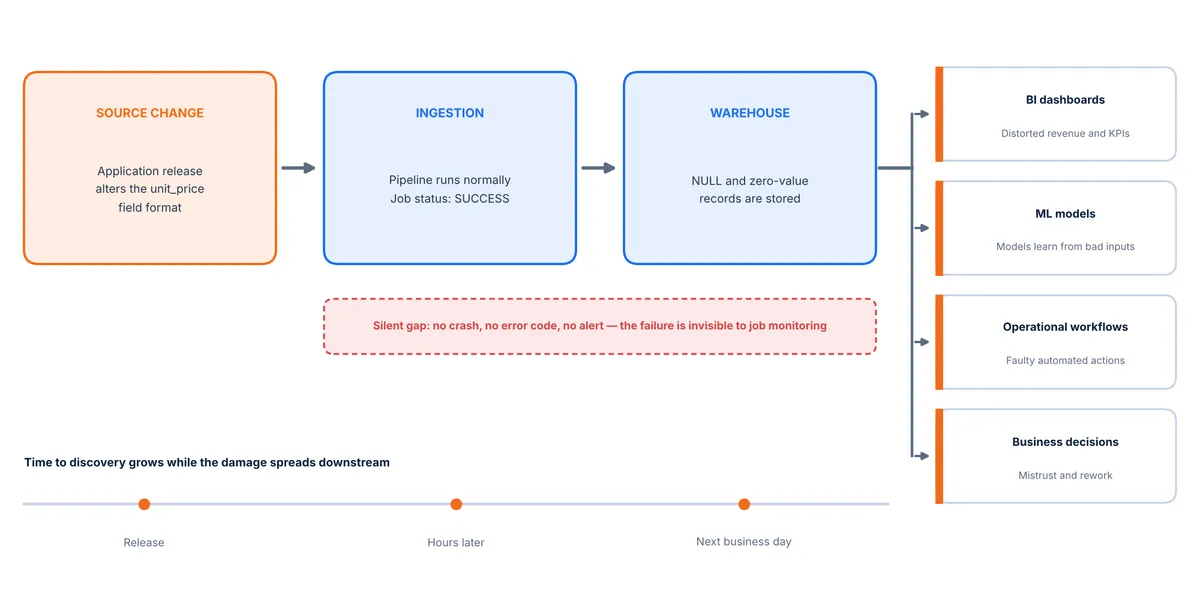
Traditional safeguards struggle with these failures. Scheduled validation inspects data at fixed moments, so bad data is live and in use between runs. Pipeline success-or-failure monitoring answers whether a job ran, not whether the data it produced is right; a load can finish green while carrying null prices, half its rows or yesterday's values. Neither approach reliably notices gradual drift. Figure 2 shows how a single silent failure travels.
Real-World Scenarios: What Poor Data Quality Costs
Scenario 1: E-Commerce Transaction Processing
The event - A large e-commerce company processes thousands of orders a minute across its website and mobile app. After an application update changes the checkout payload, product prices for certain categories begin arriving as NULL.
The failure - The records are well-formed, row counts look normal and the ingestion job reports success. Standard pipeline monitoring has nothing to flag, because nothing failed. Depending on transformation logic, the affected order lines are loaded as zero-value or silently dropped from aggregates.
The impact - Suppose one in six order lines in the affected categories carries no price for several hours. Revenue totals fall short, average order value dips and sales dashboards suggest those categories have collapsed. Merchandising may pull promotions or shift marketing spend in response to a decline that never happened.
Scenario 2: Real-Time Retail Inventory Management
The event - A retailer receives stock updates from hundreds of stores and several distribution centres. One distribution centre's feed is delayed by hours, and a retry then resends a batch of updates that were already processed.
The failure - Late records and duplicated receipts both reach the warehouse. Jobs succeed and totals look plausible, yet inventory figures no longer match what is physically on shelves.
The impact - Duplicates inflate on-hand stock, so replenishment holds back orders for products that are genuinely running low. Delayed updates make other items look scarce, triggering unnecessary transfers. The result is empty shelves for some products, surplus for others, and inventory reports that store teams stop trusting.
Scenario 3: Banking and Financial Transactions
The event - At a financial institution, an upstream processing component is delayed, and transactions reach the warehouse at a rate roughly 40% below normal for that time of day.
The failure - The warehouse stays online, queries run and dashboards refresh. But the data is incomplete, and nothing indicates that a gap exists.
The impact - Intraday financial reporting understates activity. Transaction monitoring that evaluates partial data may miss patterns that matter or raise misleading flags. Treasury and operations teams make liquidity and staffing decisions from an incomplete picture, and when the delayed records finally arrive, reported figures must be restated.
In all three cases the infrastructure worked and the data was wrong. Each needed rules to catch what is known to be invalid and continuous visibility to notice what is merely unusual. That is why data quality and observability must run continuously, not occasionally.
How Organisations Address These Challenges Today
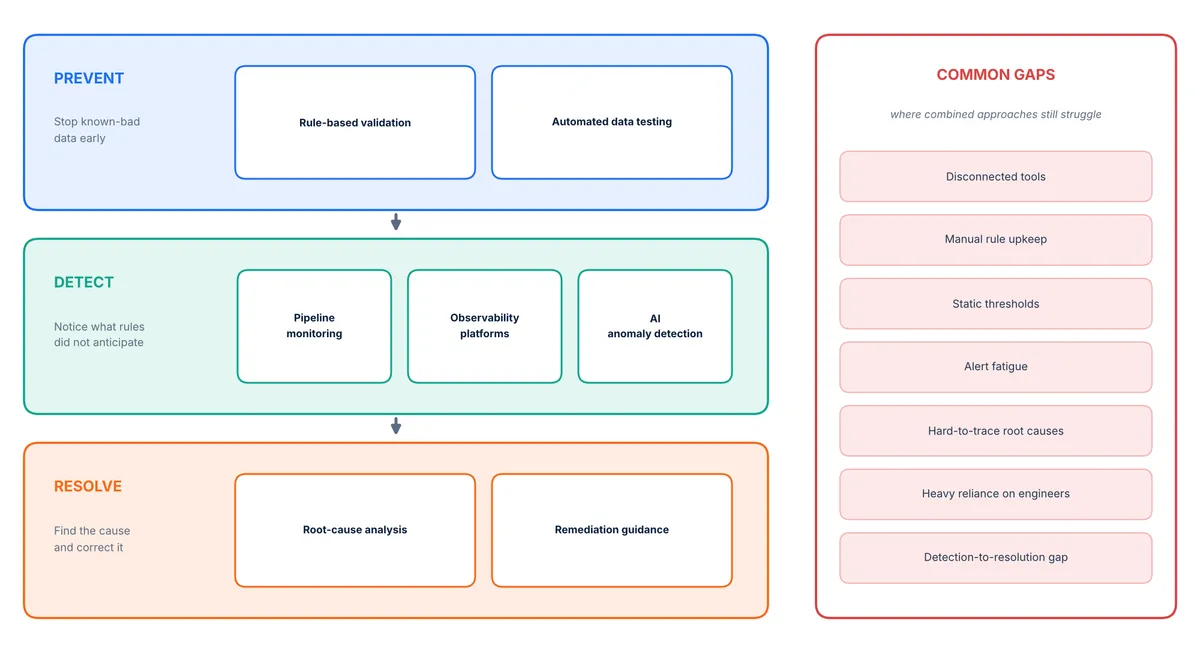
Most teams combine several complementary approaches, summarised in Figure 3:
- Rule-based data validation - Assertions covering completeness, uniqueness, accuracy, validity, consistency and custom business rules. Platforms increasingly embed these: Databricks pipeline expectations, for example, apply SQL conditions to each record and let teams choose to warn, drop invalid records or fail the update.
- Data pipeline monitoring - Tracks job status, ingestion frequency, failures, retries and processing delays, and remains essential for operational health.
- Data observability platforms - Monitor freshness, volume, distribution, schema changes and historical trends to surface anomalies that no rule anticipated.
- Automated data testing - Runs checks during ETL/ELT, transformation and warehouse loading, so defects are caught before data reaches trusted layers.
- AI-based anomaly detection - Statistical analysis and machine learning learn normal behaviour, including seasonality, and flag deviations from historical patterns.
- Root-cause analysis and remediation - Metadata, execution logs, data lineage and upstream dependencies help trace an incident to its origin and suggest corrective actions.
Each approach is valuable, but together they still leave recurring gaps:
- Disconnected tools - Validation, monitoring and observability often live in separate products with separate results.
- Manual rule upkeep - Rules must be written and revised as business logic evolves.
- Static thresholds - Fixed limits generate false positives when normal variation, such as weekend dips or promotional peaks, occurs.
- Alert fatigue - Excess notifications teach teams to ignore them.
- Hard-to-trace root causes - Complex incidents span many objects and pipelines.
- Engineering dependence - Investigation and repair queue behind a few specialists.
- A detection-to-resolution gap - Many tools stop at the alert, and fixing begins afterwards, by hand.
4DAlert: Connecting Validation, Observability and Investigation
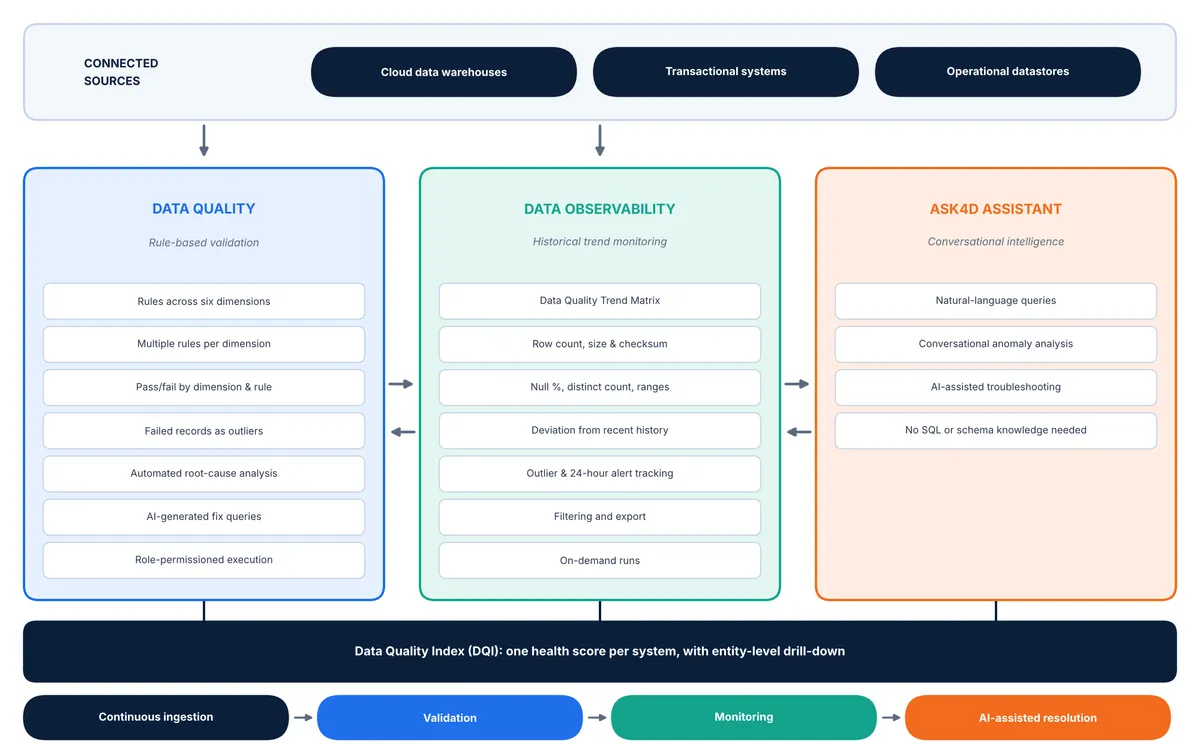
4DAlert is an Agentic AI-powered enterprise data reliability platform that connects cloud data warehouses with transactional and operational systems. It helps organizations build an AI-ready data foundation by bringing Data quality validation, historical observability, anomaly detection, and intelligent investigation into one platform. Its AI agents continuously monitor data pipelines, evaluate incoming data loads, identify unusual patterns, and investigate potential root causes. Based on their findings, they recommend corrective actions to help teams resolve data issues.
For a broader look at why these two disciplines matter in day-to-day engineering work, see Why Data Quality & Observability Matter in Data Engineering. Teams can also trigger checks on demand, ensuring reliable and consistent data for analytics and AI-driven applications.
Agentic AI for Data Quality Monitoring and Resolution
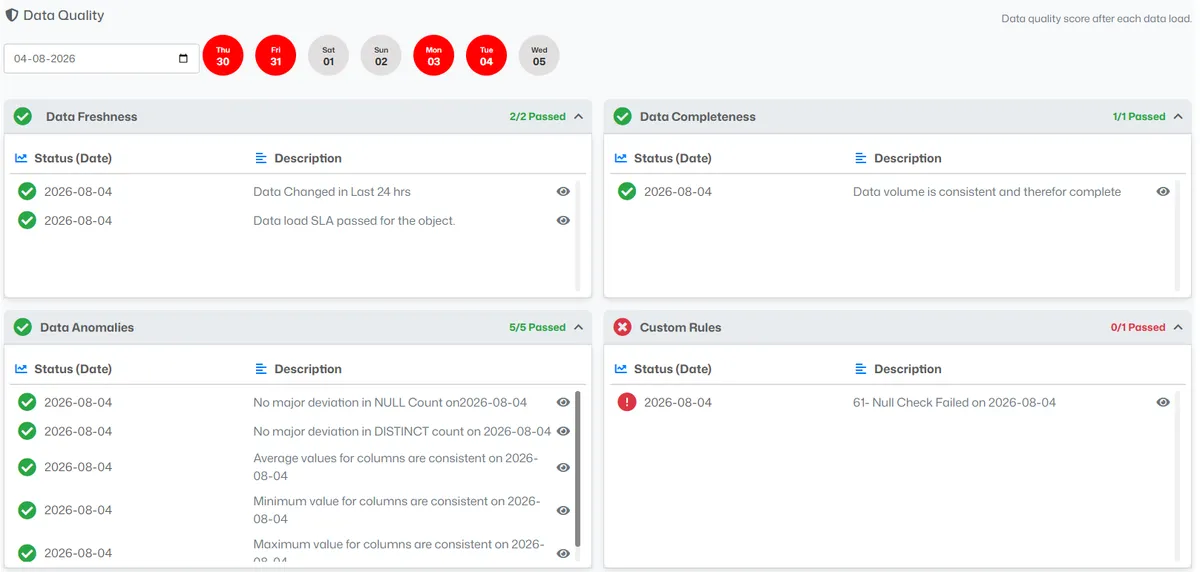
4DAlert provides configurable, rule-based validation across Accuracy, Validity, Timeliness, Completeness, Uniqueness and Consistency, and teams can define multiple rules within each dimension rather than just one. After every load, results roll up into a pass/fail view by dimension and by rule, so attention goes to the specific rule that needs it.
When a rule fails, 4DAlert returns the failing records as outliers, showing the exact rows to review rather than a single red flag. It then moves beyond detection:
- Automated root-cause analysis traces each outlier back through data and pipeline logic, reducing manual tracing of bad values.
- AI-generated corrective SQL queries turn a root-cause finding into an executable fix, instead of leaving engineers to write each one.
- Role-permissioned execution enables AI-generated queries to run against the connected system, but only within the access boundaries of the user's role.
In the e-commerce scenario, a completeness rule on unit price could surface the NULL rows as outliers, and a reviewed fix query could then be executed under the operator's own permissions.
Agentic AI for Continuous Data Observability
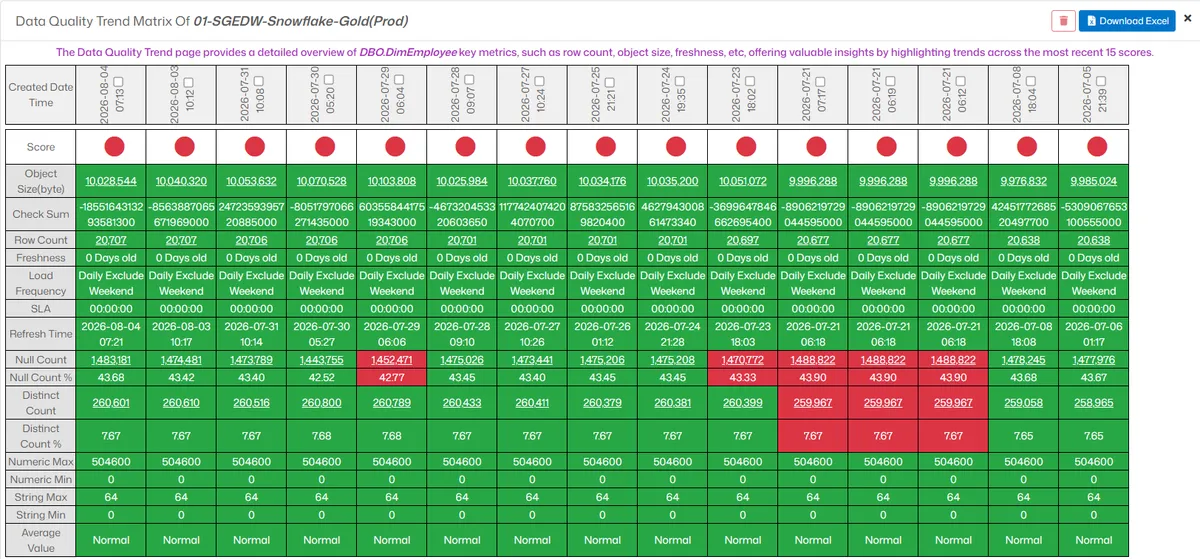
Rules catch what teams know to look for. Observability catches the rest. 4DAlert's Data Quality Trend Matrix compares recent loads of an object side by side, so engineers see how each metric has moved instead of judging a single snapshot. It tracks:
- Row count, object size and checksum, which expose loads that look successful, with normal counts, but whose contents have changed.
- Null counts, distinct counts, percentages, and value ranges, which reveal slow deviations that a point-in-time rule cannot see.
Metrics are flagged when they deviate from the object's own recent history rather than a one-size-fits-all threshold, which respects normal variance. In the inventory scenario, a duplicate-heavy load would tend to show row count rising without a matching rise in distinct count.
The Data Quality Index (DQI) rolls both layers into one score per connected system, with entity-level drill-down to the table pulling the score down. The dashboard surfaces outliers and alerts from the last 24 hours, supports filtering and export for stakeholder reviews, and lets teams run a new check on any table on demand, useful for live issues and for confirming fixes.
Ask4D and the Move Toward Agentic AI
The Ask4D GenAI assistant lets engineers, data stewards and analysts investigate in natural language, without writing SQL or knowing the underlying schema. They can ask which tables have had data quality problems in the past 24 hours, why the quality score of a customer table has dropped, or why order volume suddenly fell and which pipeline was affected. Ask4D also offers context-aware suggestions that shorten root-cause determination.
The wider industry is moving from alerts, to conversation, to Agentic AI: software agents that do not merely answer one question but plan and carry out a multi-step investigation within defined guardrails. Such agents could analyse quality results and historical trends, investigate likely root causes across connected environments, identify affected objects and downstream dependencies, recommend corrective actions, generate remediation queries and support controlled, multi-step investigation and resolution workflows.
Consider how this might unfold. Sales transactions drop sharply. An agent compares current volume with historical patterns for the same period, traces the shortfall to an upstream ingestion delay, recommends recovering the delayed load, and, once the recovery is approved and run, re-checks the data to confirm that volumes have returned to range.
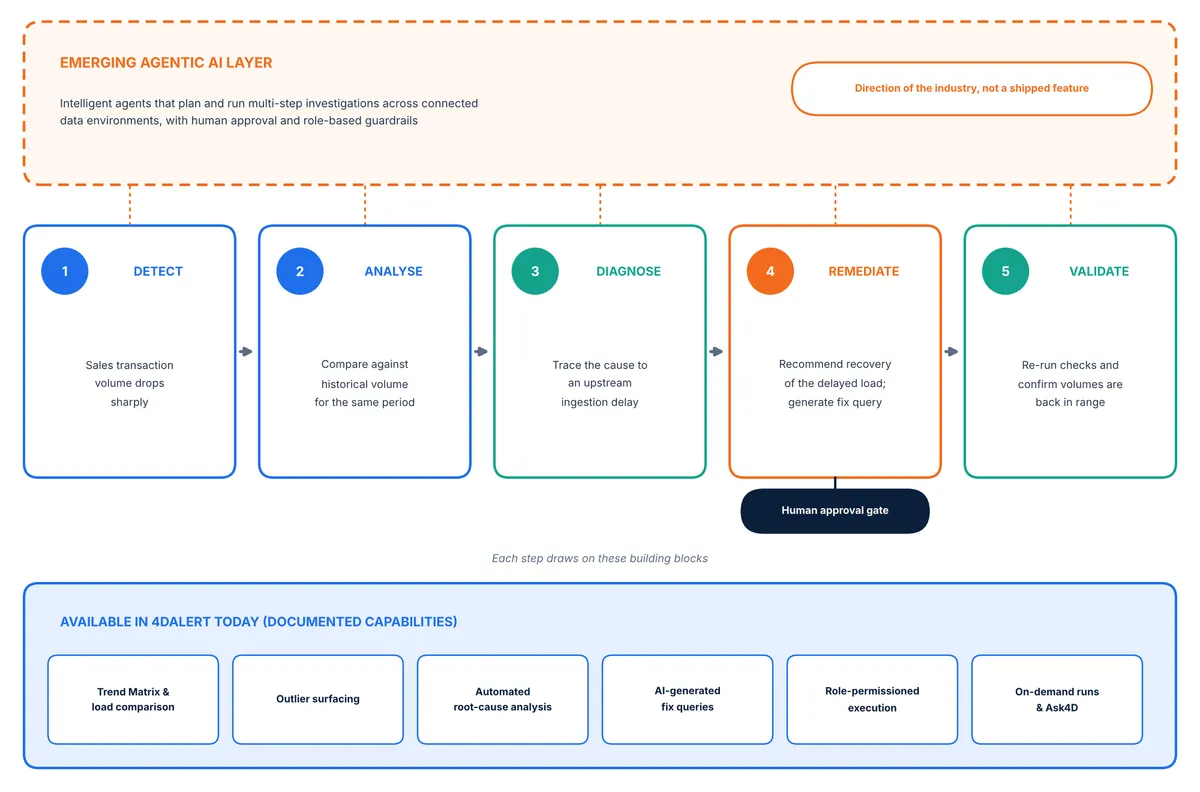
It is important to be precise about what exists today. 4DAlert's documented capabilities include trend comparison, outlier surfacing, automated root-cause analysis, AI-generated fix queries, role-permissioned execution, on-demand runs and the Ask4D assistant. A fully orchestrated AI agent running the sequence above end to end describes where the field is heading, not a claim that every step is autonomous in 4DAlert today. Agentic AI is an emerging evolution that builds on validated data, historical context and permissioned remediation, and promises to make data reliability operations more proactive.
Building Trustworthy Real-Time Data Environments
A modern warehouse needs more than fast ingestion and green pipeline runs. It needs continuous validation to enforce what must be true, historical visibility to reveal what is changing, intelligent anomaly detection to flag the unexpected, and an efficient path from alert to investigation to fix.
Combining Automated Data quality, data observability and AI-assisted intelligence moves teams from reactive troubleshooting toward proactive data reliability. 4DAlert helps organisations build that foundation by connecting these capabilities in one platform.
See your own data issues before your dashboards do.
Fast pipelines don't mean trusted data. 4DAlert checks every load against your quality rules, tracks how your tables change over time, and lets you ask Ask4D what went wrong, in plain English. When a rule fails, you get the failing rows, the likely root cause and a fix query you can run under your own permissions.
Book a demo → Pick one of your real tables and we'll show you what 4DAlert finds.