
TL;DR
Key takeaways
- The five recurring blockers in MDM implementation are poor data quality, disconnected systems, complex entity modeling, duplicate records and inaccurate matching, and untrustworthy Golden Records
- Data silos across CRM, ERP, billing, cloud and legacy systems produce inconsistent departmental reporting, duplicate customer interactions and unreliable analytics and AI models
- Static, rules-driven MDM platforms need extensive coding to change entity models; AI-powered platforms add multi-attribute similarity scoring and no-code entity configuration instead
- A trustworthy Golden Record requires explicit survivorship rules — source priority, recency, confidence, completeness or length — plus data lineage so stewards can see where each value came from
- Treat data quality as continuous, AI-driven monitoring rather than a one-time cleanup, especially as agentic AI systems begin acting on master data without human review
In the era of data-driven business, accurate and trusted data is essential for everyday operations, decision-making, and AI initiatives. As businesses expand, master data is spread across CRM, ERP, finance, cloud and legacy systems, all with their own version of customer or product data. The outcome: duplicate records, inconsistent values, and disjointed data that can lead to inaccurate reporting, poor analytics and AI models.
Master Data Management addresses this by unifying master data from various systems into one trusted source of truth: accurate, governed, and standardized records. Successful MDM implementation will enhance data quality, remove data duplication, and enhance governance, making MDM a strategic business capability rather than a back-office operation. However, it is not an easy task to implement: organizations often struggle with data quality, disconnected systems, complex entity relationships, inaccurate duplicate detection, inconsistent Golden Record creation, weak governance, and challenges with synchronizing data across applications.
The challenges are addressed by modern AI-powered platforms that offer flexible entity modeling, AI-powered Match & Merge, intelligent hierarchy management, Golden Record creation, data governance and stewardship, real-time integration, and AI-driven monitoring. One such platform is 4DAlert, designed to make Master Data Management implementation easier and enhance data quality, governance and efficiency.
MDM software selection isn't just an IT purchase — it's a strategic bet on whether your business can trust the data behind every future AI-driven decision.
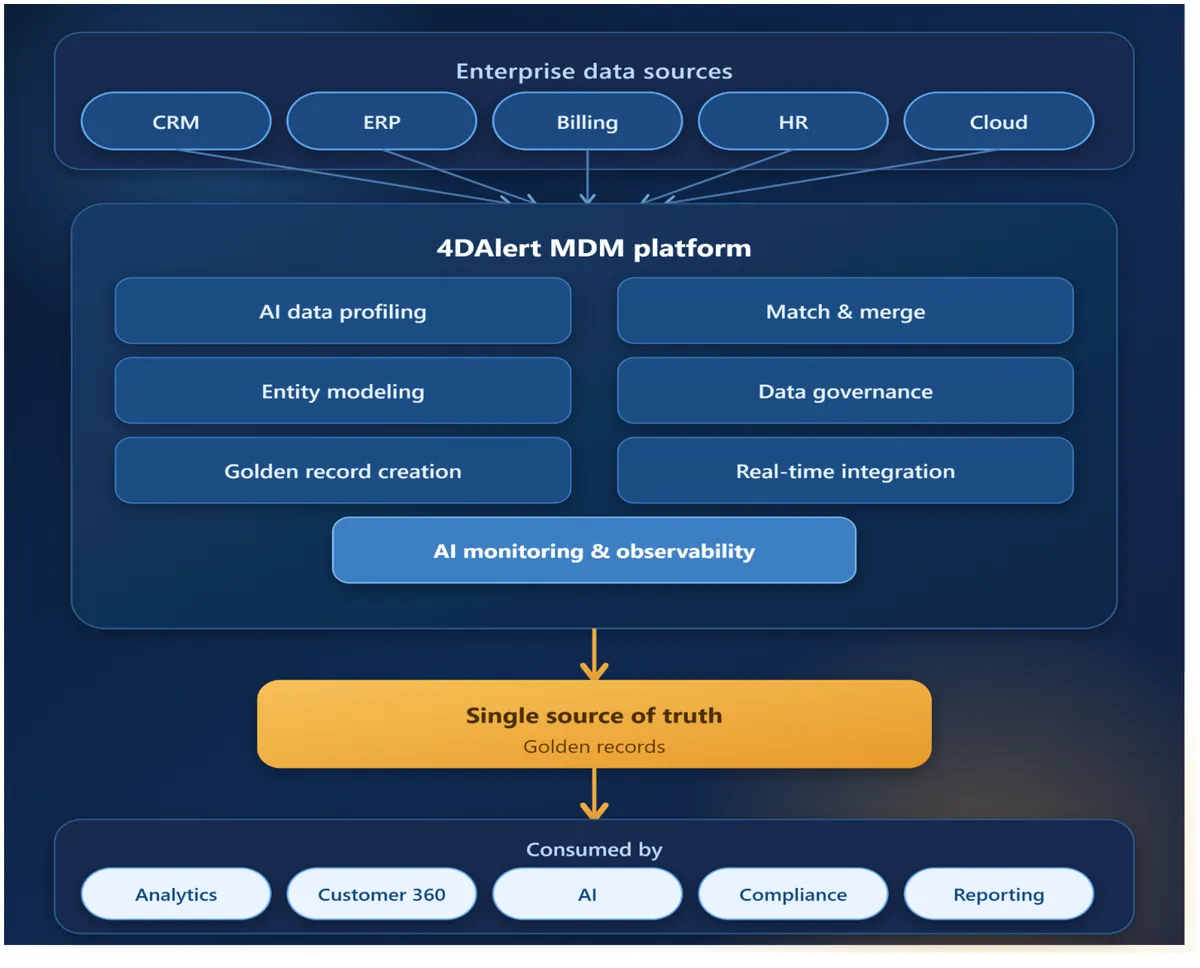
Figure 1. Overview of the 4DAlert MDM platform showing how enterprise data from multiple source systems is unified through AI-powered data profiling, entity modeling, match & merge, governance, Golden Record creation, real-time integration, and continuous monitoring.
Why MDM Implementations Are Challenging
A Master Data Management (MDM) solution is not just about connecting data from various systems. It demands that organizations define business terms consistently, enhance data quality, remove duplicate data, deal with complex entity relationships, and maintain master data across the enterprise. The amount of master data grows with the expansion of businesses and the use of cloud applications, AI and advanced analytics.
The typical path to Master Data Management begins with good intentions, but quickly slows down due to fragmented data, inconsistent rules, manual governance, and Golden Records that lose trust as they gain. It's typically because of the platform: static, rules-driven systems that aren't scalable to the business.
AI-powered platforms such as 4DAlert overcome these implementation challenges by providing intelligent automation and flexible entity modelling, AI Match & Merge, Golden Record generation, governance, real-time integration and ongoing monitoring. These capabilities enable organizations to ease the implementation of Master Data Management, enhance data quality, governance, and operational efficiency.
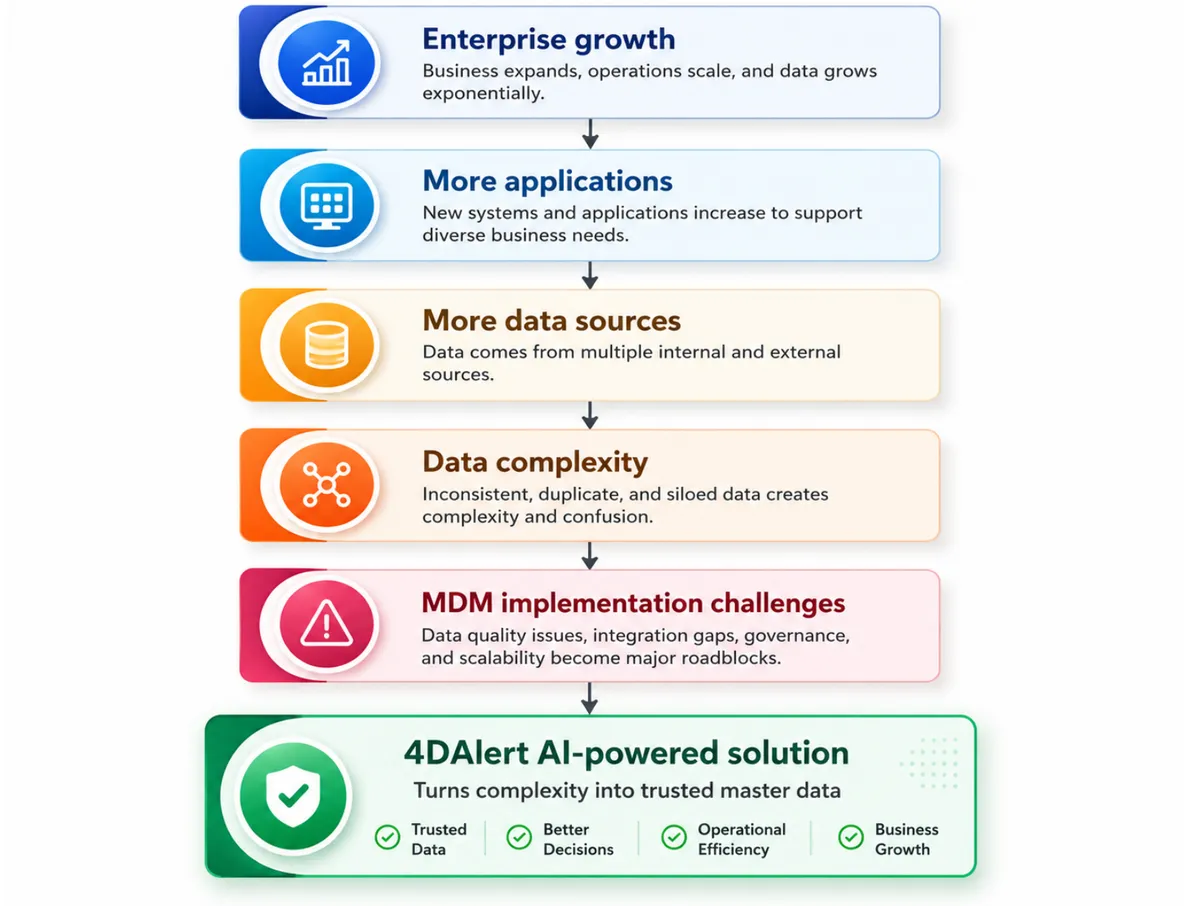
Figure 2. Growth in enterprise applications increases data complexity and MDM implementation challenges, while 4DAlert's AI-powered platform transforms fragmented data into trusted master data.
Top Challenges in Master Data Management Implementation
Challenge 1: Poor Data Quality
The backbone of any successful Master Data Management project is data quality. Master data is typically gathered from a variety of internal and external sources like CRM, ERP, spreadsheets, and legacy databases. These systems are independent and can have inconsistent, incomplete, outdated or inaccurate information in the same business entity.
Common data quality issues include:
- Duplicate customer or supplier records
- Missing mandatory attributes
- Inconsistent naming conventions
- Invalid or outdated information
- Different data formats across systems
How 4DAlert Solves This Challenge
4DAlert tackles these issues with intelligent data ingestion, validation, profiling, and data quality and observability. The platform supports organizations to detect inconsistencies, validate attributes and ensure high quality master data for downstream operations like Match & Merge and Golden Record generation before data is added to the MDM repository. This proactive approach minimizes manual data cleansing and enhances the overall success of MDM implementation.
4DAlert treats data quality as a continuous, AI-driven process rather than a one-time cleanup:
- AI-driven field profiling scans incoming data automatically, classifies every field, and flags quality issues with a confidence score - instead of a data steward manually inspecting every column.
- Real-time observability monitors data quality continuously across the MDM lifecycle, catching anomalies and schema drift as they happen rather than weeks later during a report reconciliation.
- Governance dashboards surface exactly which records failed quality rules and by how much — giving stewards a prioritized queue instead of a spreadsheet full of unknowns.
As agentic AI systems increasingly act on this data without human review, 4DAlert's continuous quality monitoring becomes the safeguard that keeps those actions trustworthy.
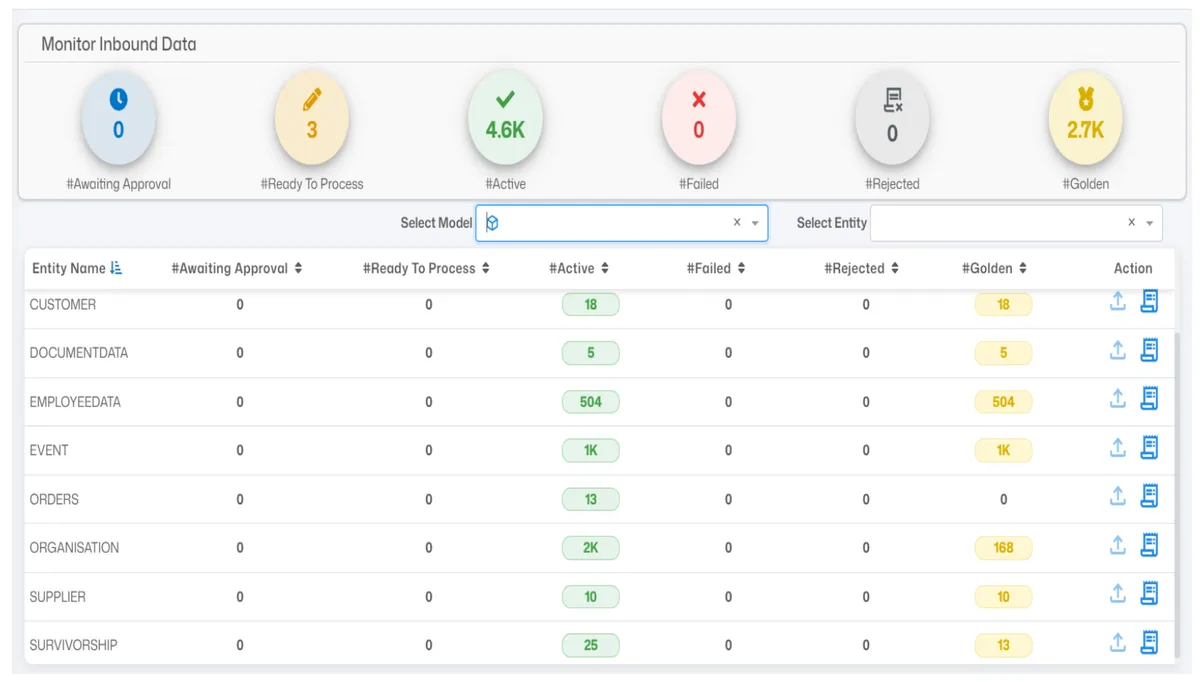
Figure 3. Real-time data quality monitoring in 4DAlert
Challenge 2: Disconnected Systems and Data Silos
As businesses expand, master data is spread out between CRM, ERP, billing, cloud applications, data warehouses, and legacy systems. Such systems frequently have their own customer, product, supplier or location information, making it challenging to have a single view of the same business entity. Data silos can cause duplicate data, conflicting business perspectives, and inconsistent records. The more applications, data sources, or business units are added, the more complex it becomes and the more difficult it becomes to manage and maintain the manual reconciliation.
What it will cost the business:
- Inconsistent Business Reporting – Different departments might be getting different reports, since each system stores its own version of the same data, resulting in inaccurate business insights and delayed decision making.
- Duplicate Customer Interactions – When there are multiple versions of the same customer record, it can lead to duplicate communications, which can impact customer trust and the success of sales and marketing efforts.
- Lower Quality of Analytics and AI – Analytics platforms and AI models depend on quality master data. They give inaccurate predictions and insights when trained on inconsistent or fragmented data.
How 4DAlert Solves This Challenge
4DAlert breaks down data silos by connecting master data from various enterprise systems to a single Master Data Management platform. The platform's Data Acquisition functionality pulls data from CRM, ERP, databases, cloud applications, APIs and other source systems, providing a single source of enterprise master data.
4DAlert standardizes data, detects duplicate records and merges them into one trusted source of truth using Flexible Entity Modeling, AI-powered Match & Merge and Golden Record Creation. This guarantees that all business apps are operating on the same and accurate master data.
In addition, real-time integration, data governance, and AI-powered monitoring continuously synchronize and monitor master data across connected systems. This allows organizations to enhance data consistency, ensure robust governance, and make informed business decisions with confidence on reliable enterprise data.
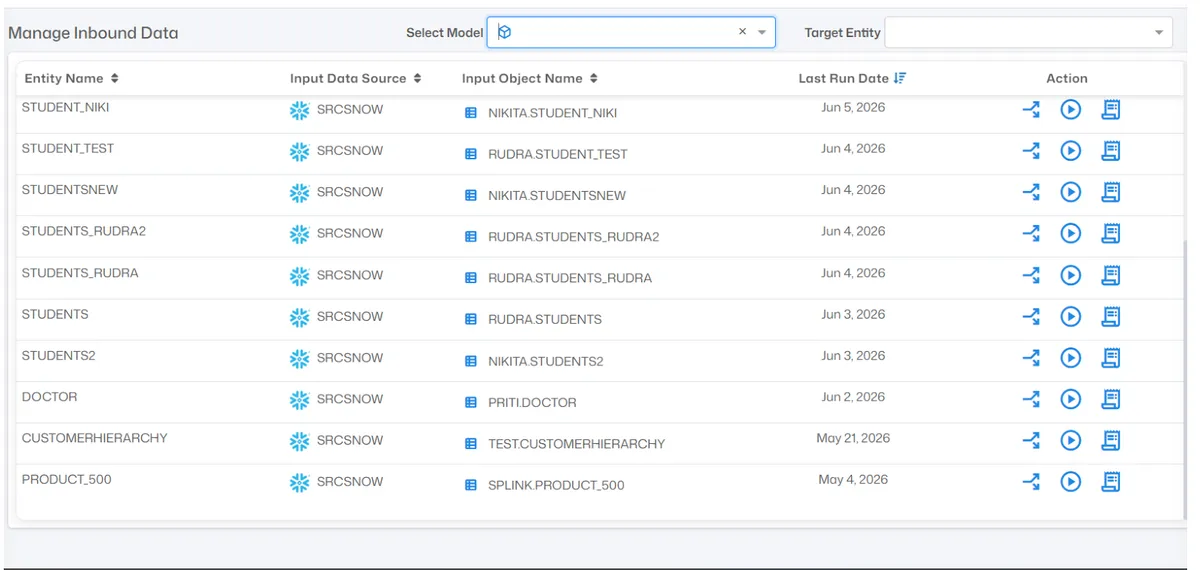
Figure 4. 4DAlert's Manage Inbound Data screen, consolidating datasets from multiple source systems into a single centralized platform.
Challenge 3: Complex Entity Modeling
Managing master data becomes more complex as organizations expand, with many business entities and their interdependencies. Each of these entities – customers, suppliers, products, employees and locations – has its own set of attributes, business rules and dependencies that need to be captured correctly in the Master Data Management platform. Implementing new entities, attributes, or relationships with traditional Master Data Management solutions can be time consuming and challenging, as it involves extensive coding and database changes.
Typical MDM systems have to be designed from the ground up, with the organization creating entity models, defining relationships, and creating validation rules. These models may need to be changed as business needs change, which typically requires substantial development effort, longer implementation time and higher implementation cost.
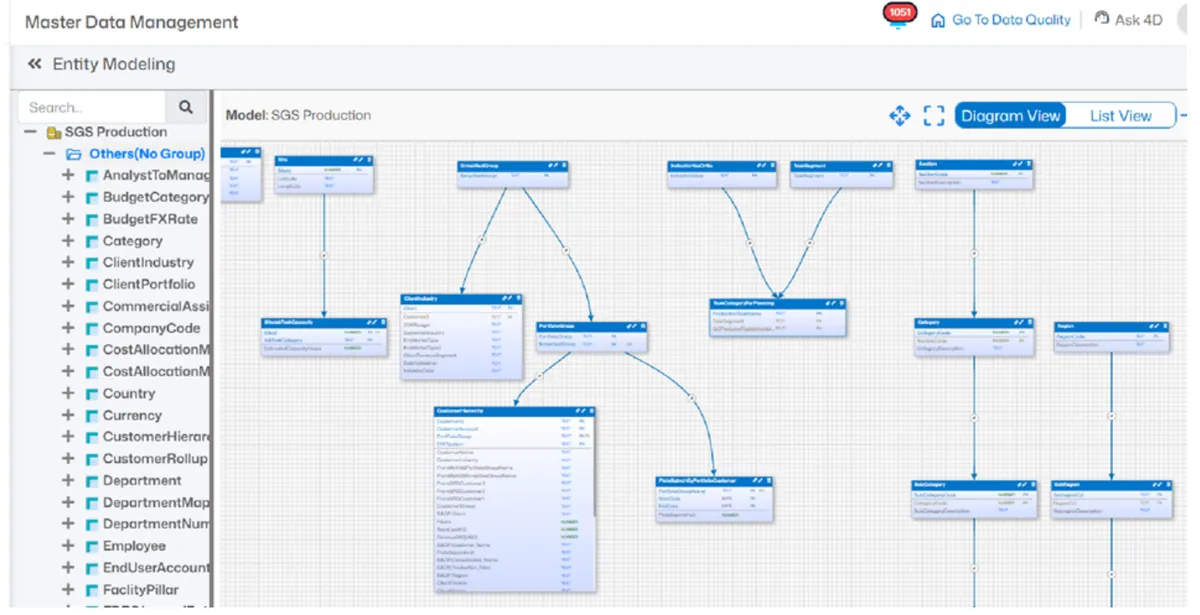
Figure 5. 4DAlert's Entity Modeling workspace visualizes business entities and their relationships for scalable master data management.
How 4DAlert Solves This Challenge
- Through a no-code interface, Flexible Entity Modeling enables organizations to define custom entities and set attributes, primary keys, uniqueness constraints, validation rules, security settings, and Golden Record fields. This allows for easier change of the master data model when business needs change.
- Intelligent Hierarchy Management allows organisations to establish parent-child and multi-level relationships between business entities and to show the dependencies. Adjustments to the business hierarchy can be centrally controlled and tracked as the business grows.
- Visual Entity Modeling gives users a graphical representation of entities and their relationships, helping them to understand the structure and connections of master data within the organization. This simplifies the design, management and maintenance of complex data models.
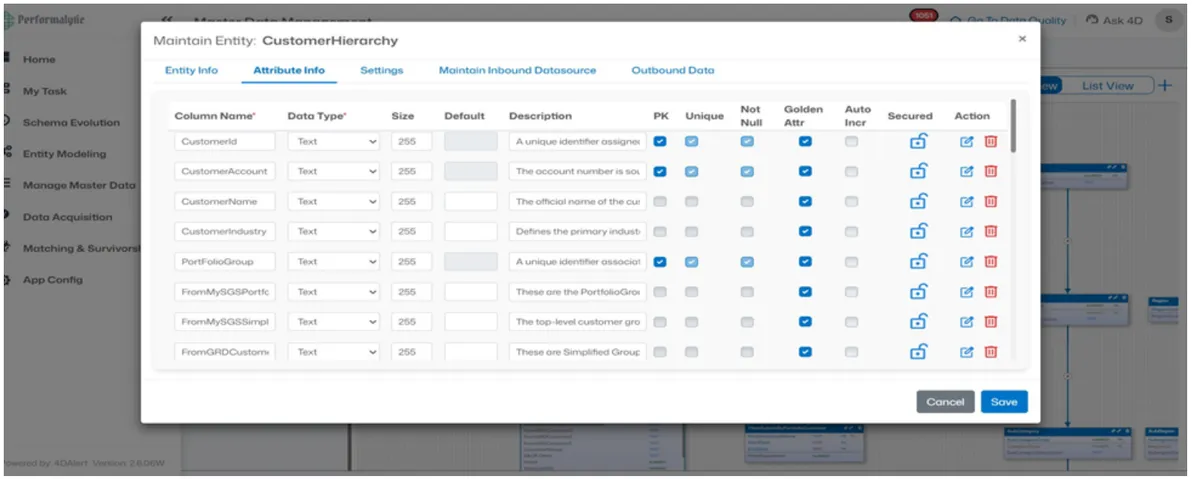
Figure 6. Configuring entity attributes, primary keys, uniqueness constraints, and Golden Record settings in 4DAlert.
Challenge 4: Duplicate Records and Inaccurate Matching
One of the most prevalent problems in Master Data Management is duplicate records. The same business entity may be present in more than one system, under a variety of names, formats, or with only partial information. For instance, a customer might show up in the CRM, ERP and billing systems in different ways and it will be hard to know if they're the same customer. These discrepancies result in disjointed master data, reporting inaccuracies, and incomplete customer, supplier, or product information.
Duplicate records are more difficult to manage as organisations continue to merge data from a variety of sources. These can lead to various problems if not addressed, such as fragmented business insights, duplicate customer interactions, decreased operational efficiency, and unreliable analytics affecting strategic decision-making.
How 4DAlert Solves This Challenge
- Unlike traditional match and merge methods that rely on a single attribute, AI-Powered Match & Merge leverages intelligent similarity scoring to compare multiple attributes at once, ensuring accurate duplicate identification even with spelling variations, abbreviations, or inconsistent formats.
- Configurable Matching Rules enable administrators to specify match fields, assign attribute weights, select Exact or Fuzzy matching, and set similarity thresholds to ensure that duplicate detection is accurate as per the business requirements.
- Automated Review and Performance Optimization integrates configurable approval thresholds, blocking rules and AI-based field recommendations to reduce manual workload, enhance matching accuracy and process vast amounts of master data efficiently.
This same automation is what makes master data safe to hand to agentic AI — an agent working from unresolved duplicates will act on the wrong record just as confidently as the right one.
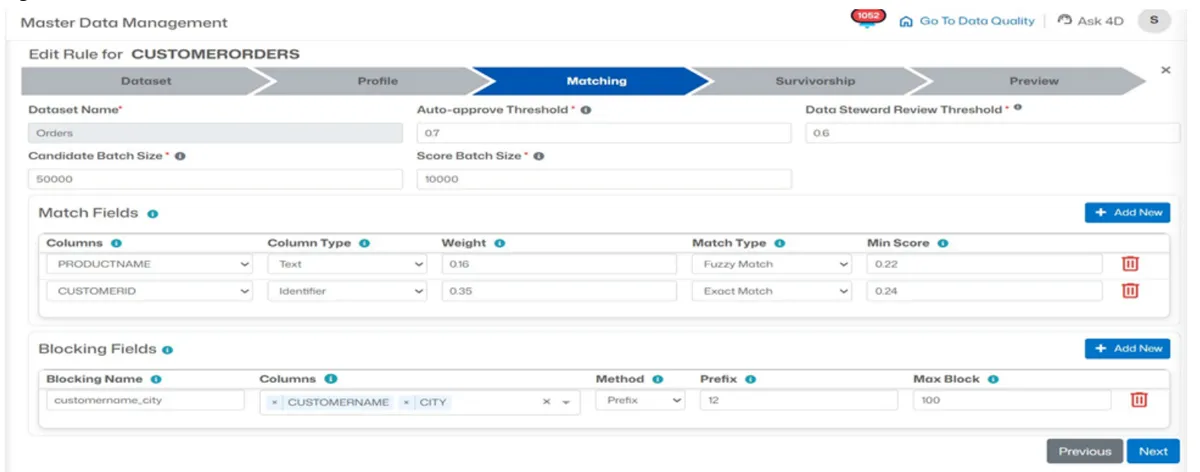
Figure 7. Configuring AI-powered Match & Merge rules in 4DAlert using match fields, similarity scores, and blocking rules to identify duplicate records.
Challenge 5: Ensuring Accurate Golden Record Creation
Once duplicate records are identified, organizations need to figure out which attribute values are the most accurate and up to date. Information from various systems might be incomplete, outdated, or conflicting, and a clear survivorship strategy is crucial for developing a reliable Golden Record.
Why Golden Record Creation Is Challenging
The main problem with making Golden Records is determining which source to trust for each attribute. One system might have the most accurate address, and the other might have the newest phone number. 4DAlert solves this by implementing source prioritization, conflict resolution and attribute level survivorship rules, which ensure that the most suitable value is kept for each field. Data lineage also gives data stewards insights into where Golden Record values come from, which enables them to validate and trust the consolidated record. The outcome is a continually updated Golden Record that becomes the authoritative source of connected business applications.
How 4DAlert Solves This Challenge
- AI-Assisted Golden Record Creation: 4DAlert combines data from various source systems and uses configurable survivorship rules to decide which attribute values should be included in the Golden Record.
- Source Prioritization and Conflict Resolution: If there is a conflict between source records, different rules can be used to select the most appropriate value, such as source priority, recency, confidence, completeness, or data length.
- Data Lineage and Continuous Maintenance: 4DAlert follows the lineage of attribute values to give visibility into how the Golden Record was formed. A record is continuously maintained and is a source of authority for connected applications.
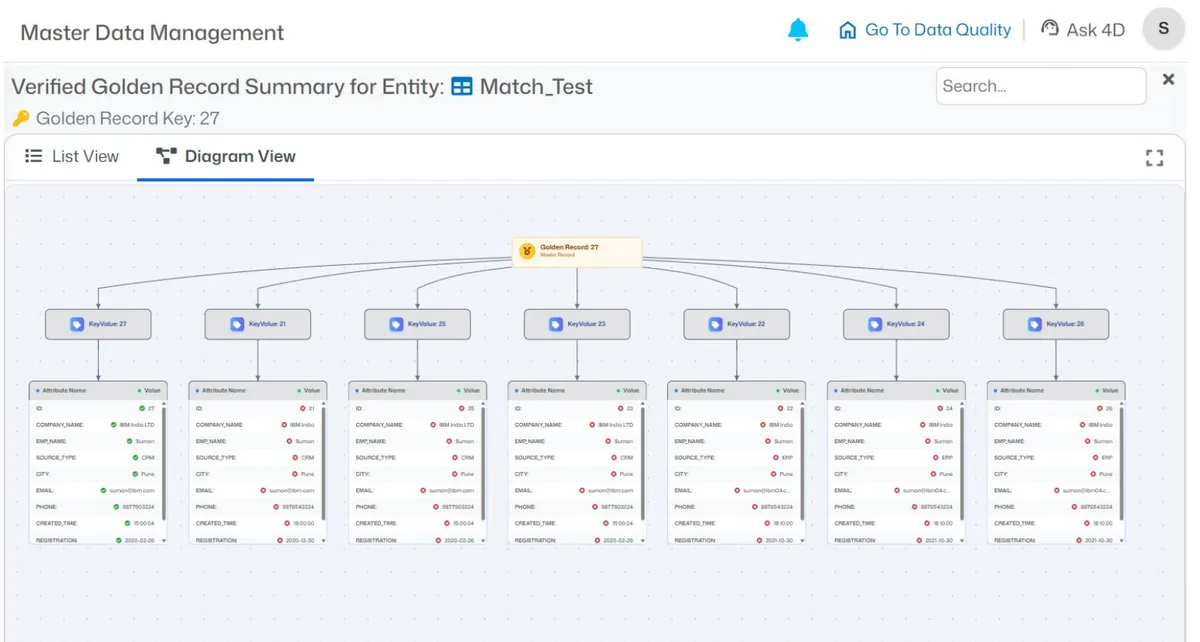
Figure 8. 4DAlert Golden Record view showing the consolidation of multiple source records into a single trusted master record.
Conclusion
While it's about bringing data together into one repository, MDM implementation isn't just about that — it's about data quality, disconnected systems, complex entity structures, duplicate records, and trustworthy Golden Record creation — if any of these aspects are not addressed, the result is inconsistent information, manual reconciliation and unreliable decisions. 4DAlert solves all of these with flexible entity modeling, AI-powered Match & Merge, Golden Record creation, data governance, real-time integration and continuous monitoring, and transforms disjointed and inconsistent data into accurate, governed master data with significantly less manual work. Master data isn't simply about cleaning up data, it's about having a trusted foundation for making better decisions, analyzing data, creating AI, and delivering better customer experiences — and it's the foundation that increasingly agentic AI organizations can rely on to make decisions on their behalf.
Frequently Asked Questions
What are the biggest challenges in MDM implementation?
Five recur: poor data quality, disconnected systems, complex entity modeling, duplicate records with inaccurate matching, and Golden Records that users do not trust.
How do data silos affect master data?
When CRM, ERP, billing, cloud and legacy systems each hold their own version of an entity, departments report inconsistent numbers, customers get duplicate interactions, and analytics and AI models become unreliable.
Why is entity modeling hard in traditional MDM?
Static, rules-driven platforms need extensive coding to change an entity model. AI-powered platforms add multi-attribute similarity scoring and no-code entity configuration instead.
What makes a Golden Record trustworthy?
Explicit survivorship rules such as source priority, recency, confidence, completeness or length, plus data lineage so stewards can see where each value came from.
Is data quality a one-time cleanup?
No. Treat it as continuous, AI-driven monitoring, especially as agentic AI systems begin acting on master data without human review.