
AI-Powered MDM
MDM and Data Governance: How Master Data Management Makes Governance Work
TL;DR
Key takeaways
- Data governance is the policy layer that defines ownership, standards and quality rules; master data management (MDM) is the enforcement layer that applies them to the entities the business depends on most
- MDM enforces governance by merging records from every source into a single golden record, applying survivorship rules, and routing exceptions to data stewards
- Start with the one record type that causes the most pain, such as supplier or material, rather than all your data at once
- Avoid three common mistakes: buying the tool before deciding who owns what, fixing every entity at once, and treating cleanup as a one-off project
Most enterprises have a data governance policy, but far fewer can show it working inside their systems. Supplier, customer and product data is created and edited across ERP, CRM, procurement, quality and finance platforms, each holding its own version of the same entity. The result is fragmented spend visibility, duplicate payments, inconsistent compliance reporting and slow audits. The cause is architectural: the policy defines ownership and standards, but nothing in the data layer enforces them.
The short answer: Data governance defines the policies, ownership and quality standards for enterprise data. Master data management (MDM) enforces them on the entities the business depends on most, by merging records from every source into a single trusted golden record, applying survivorship rules, and routing exceptions to data stewards. Governance is the policy layer. MDM is the enforcement layer.
Below, we cover how that works in practice, what to look for in a platform, and where to start.
What is the difference between data governance and MDM?
Think of data governance as the house rules for your data. It decides who owns supplier data, what counts as a duplicate, and who is allowed to change a record. Master data management (MDM) is the day-to-day work of keeping those rules true. It pulls your key business records together from every system, cleans them up, and maintains one authoritative version of each supplier, customer or product.
In short: governance decides, MDM delivers. For an independent overview of how MDM and governance work together, see DATAVERSITY’s guide, What Is Master Data Management?.
|
Governance defines |
MDM delivers |
|
Data ownership and stewardship |
A central place where stewards review and manage records |
|
Quality standards |
Automated deduplication, validation and survivorship |
|
Common business definitions |
A unified entity model and golden records |
|
Compliance requirements |
Traceable, auditable master data |
|
Control and consistency policies |
Rule-based management across systems |
How does one supplier end up in four systems?
This is an illustrative scenario based on a common pattern in manufacturing, not a named customer story.
Picture a manufacturer with five plants. Each region runs its own ERP, procurement works in another tool, quality uses a third, and finance has a fourth. Nobody planned the mess. It built up over the years, one system at a time, and each one kept its own copy of the same steel supplier: Northwind Steel in the ERP, NORTHWIND STL LTD in procurement, and so on.
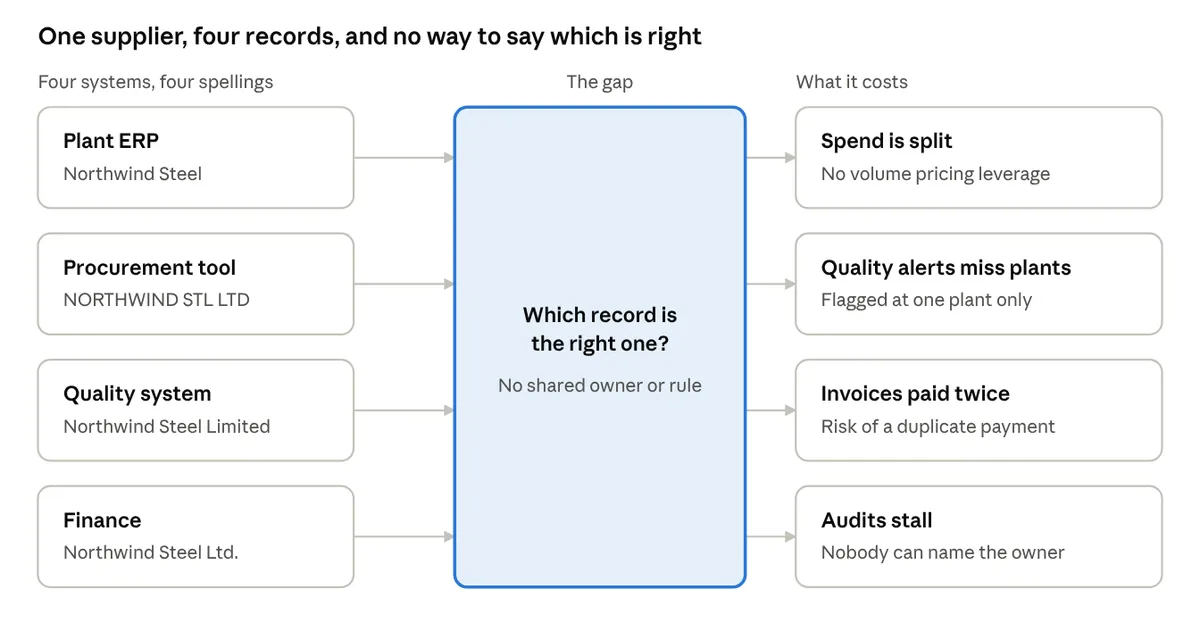
before · one supplier in four systems
Same supplier, four spellings, no shared rule. That gap is where the cost comes from.
The cost rarely arrives as one big failure. It shows up as small, expensive surprises. Purchasing can't see total spend with the supplier, so it can't ask for a better price. A quality alert on a bad batch reaches one plant and misses the others. Finance risks paying the same invoice twice under two supplier records. And when an auditor asks who owns supplier data, the room goes quiet.
Every team is doing its job properly. What's missing is a shared record that carries the rules.
How Does AI-Powered MDM Make Data Governance Actually Work?
In plain terms, MDM takes each governance rule and gives it a job to do inside your systems. With our supplier example, that comes down to six things.
- It works out who is who - AI-driven matching spots that the four records are really one company, even when the names don't match exactly, like Northwind Steel and NORTHWIND STL LTD, and merges them into a single golden record. From then on, every report starts from the same supplier.
- It settles the arguments - When systems disagree on a legal name, tax ID or payment terms, survivorship rules decide which source wins. The answer is the same every time, instead of depending on who edited the field last.
- It gives your data stewards a proper workspace - Instead of checking every record by hand, stewards focus on the borderline matches and conflicts that need a human decision, and approve changes in one place.
- It keeps a paper trail. When an auditor asks where a value came from and who changed it, you have an answer. That helps with supplier compliance, financial reporting and privacy rules.
- It keeps every system in step - Fix a record once and the correction reaches the ERP, procurement, quality and analytics, so the same mess doesn't come back next quarter.
- It grows with you - AI-assisted matching and rules cope with volumes that spreadsheets and manual checks never will, and continuous monitoring flags anomalies before they reach your reports.
How does 4DAlert solve this?
Back to our manufacturer. Here's how it plays out with 4DAlert's AI-powered MDM and Entity Resolution platform.
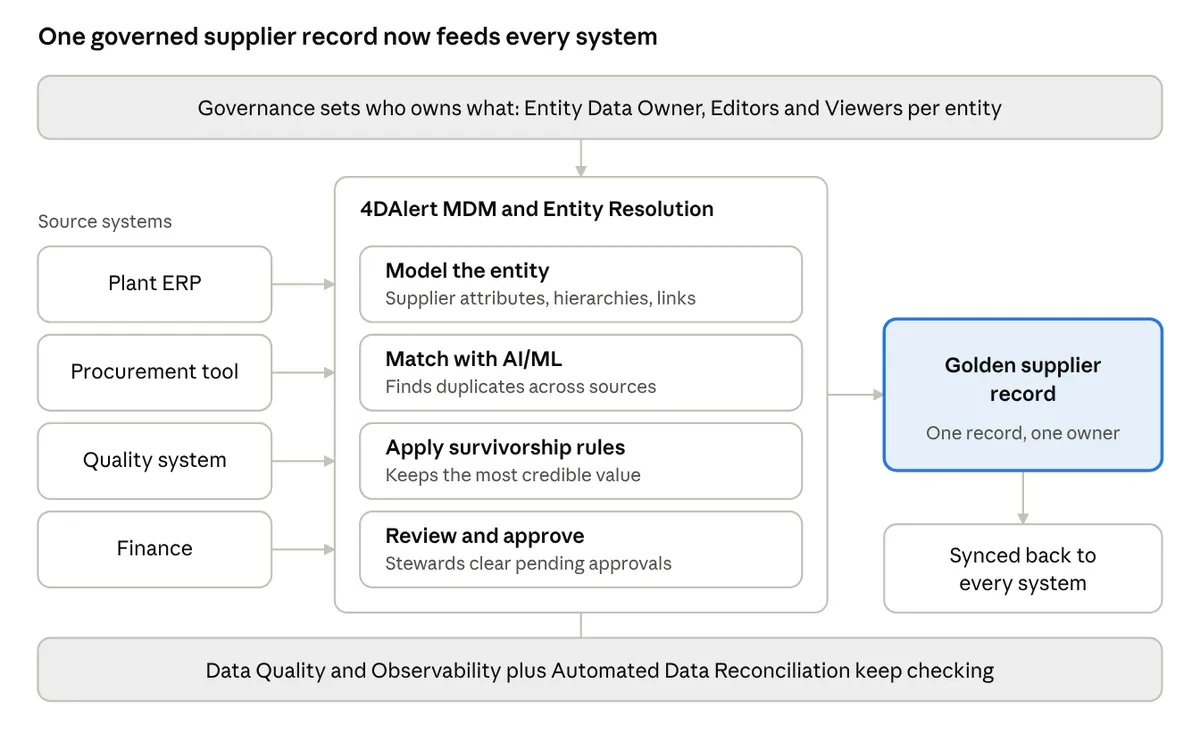
after · supplier flow through 4DAlert
Four systems feed one governed record, and corrections flow back so the problem doesn't return.
Start by defining what a supplier is - The team models the Supplier entity once, with its attributes, hierarchies and relationships, so the governance definition lives in the data itself and not only in a policy document.
Put names against it - Every entity gets an Entity Data Owner who is accountable for it and its quality, Entity Data Editors who can change it, and Entity Data Viewers who can see it. The team also decides which systems feed the entity and where the clean record goes next.
Let AI do the heavy lifting - AI/ML models spot the duplicate supplier records across the four systems, and survivorship rules keep the most credible value for each field. The result is one golden supplier record people can trust.
Keep it clean - The work doesn't stop after the first cleanup. Validation keeps running, and with 4DAlert's Data Quality & Observability and Automated Data Reconciliation, the checks reach beyond master data into your pipelines and reports.
Spot trouble early - Owners and stewards get one dashboard showing failing records, approvals waiting on someone, and golden records by status: needs review, auto approval and unique. Problems surface on a Tuesday morning instead of in the middle of an audit.
For our manufacturer, that means purchasing finally sees total spend per supplier, a quality alert reaches every plant that buys from that supplier, and the audit question has a named owner and a history behind it.
Where should you start with MDM and data governance?
Not with all your data. Start with the one record type that causes the most pain. For manufacturers, that's often supplier or material. Here are the five steps, and what each one looks like in 4DAlert.
- Pick one entity and define it: Choose the entity that causes the most rework and agree on what it contains. In 4DAlert, you model the entity once, with its attributes, hierarchies and relationships, so the definition lives in the platform and not in a slide deck.
- Name an accountable owner: Every entity needs people behind it. In 4DAlert's Maintain Entity screen, you assign the Entity Data Owner, who is accountable for the entity and its quality, the Entity Data Editors who can change its data, and the Entity Data Viewers who can see it. The same screen holds the entity's attributes, settings, inbound sources and outbound data flows.
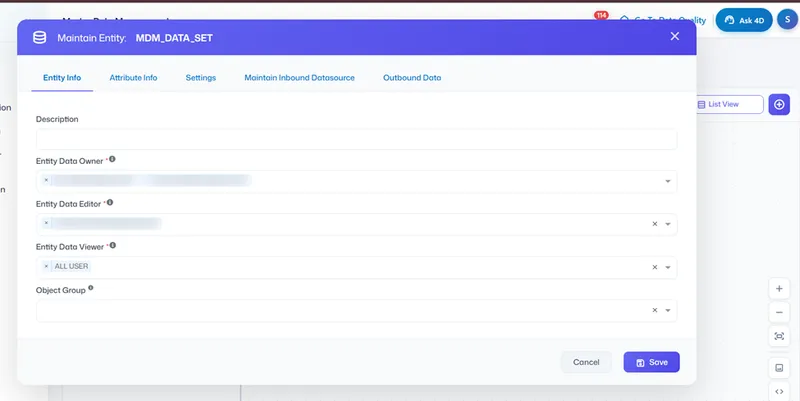
Ownership and access are set per entity in the Maintain Entity screen.
- Write down the matching and survivorship rules: Decide what counts as a duplicate, which fields are mandatory and which source wins when values conflict. In 4DAlert, you configure matching rules with weighted match fields, exact or fuzzy matching, and thresholds that separate matches accepted automatically from those a data steward reviews.
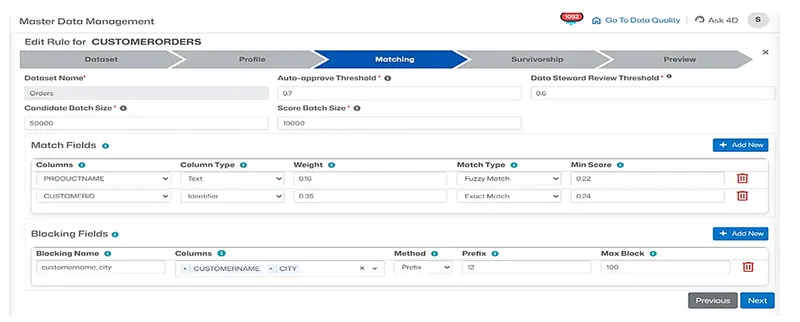
Matching rules: match fields, weights, thresholds and blocking fields.
- Consolidate, match and create golden records: Run the rules across your sources and let the platform build the golden record. 4DAlert's golden record view traces each record back to the CRM and ERP records that contributed to it, so stewards can compare values across sources.
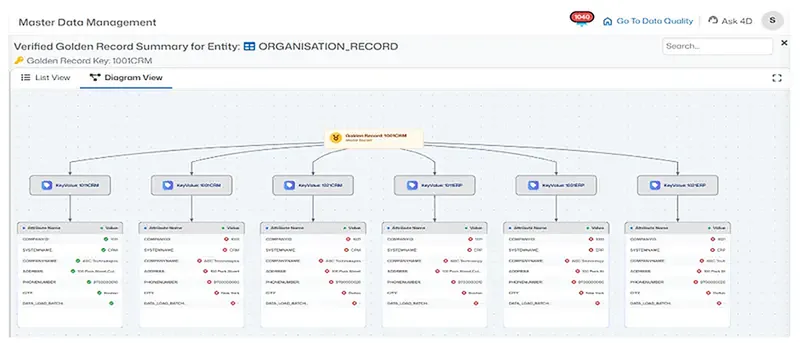
A verified golden record in diagram view, linked to its source records.
- Track exceptions, then add the next entity: Watch failing records and approval backlogs, and expand only when the first entity is stable. 4DAlert's home dashboard shows records that failed data quality rules, master data waiting for approval, golden records by status (need review, auto approve and unique) and active records by entity.
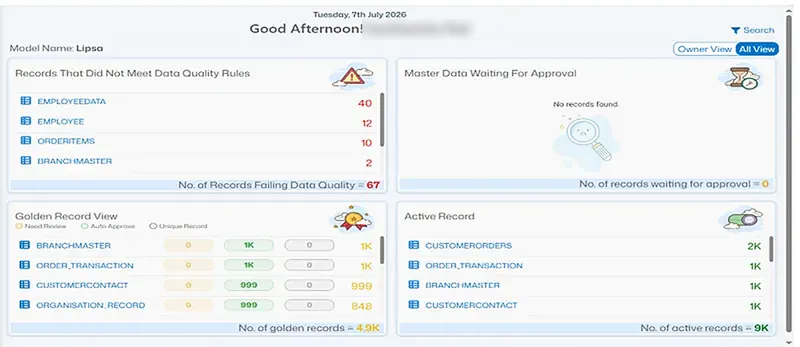
The dashboard owners and stewards see first.
Because Data Quality & Observability sits alongside MDM, you can also watch the health of the underlying tables over time, including row counts, freshness, null counts and distinct counts, and spot drift early.
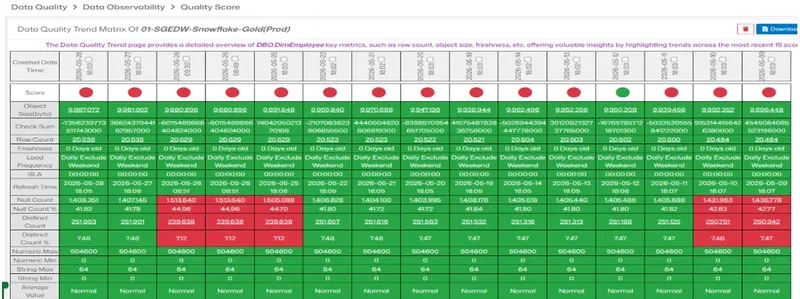
Quality trend matrix for a monitored table.
What mistakes should you avoid?
Three mistakes come up again and again. Teams buy the tool before deciding who owns what. They try to fix every entity at once, which is how programs stall. And they treat cleanup as a one-off project, when data drifts and the mess is back within a year.
What should you look for in a Master Data Management platform?
Whichever platform you look at, ask whether it has:
- Entity models that match your business definitions
- Ownership and access set per entity
- Automated matching with configurable survivorship rules
- A visible history of where values came from and how they changed
- Continuous monitoring, not a one-time cleanup, with a dashboard stewards will actually use
4DAlert is built around these checks: entity modeling, ownership and access set per entity, AI/ML matching with configurable survivorship rules, traceable golden records, and continuous monitoring. For a fuller checklist, see AI-Driven Master Data Management Software Features You Should Look For.
Conclusion
Data governance and MDM aren't rival projects. Governance gives you the rules and the accountability. MDM gives those rules something to run on: golden records, stewardship, an audit trail and consistency across systems. Without enforcement, governance stays a document people work around. With MDM, it shows up in the data.
Want to see how this works on your own data? Book a demo or start your free trial to see how 4DAlert helps you govern master data with confidence.
Frequently Asked Questions
What is the role of MDM in data governance?
MDM puts governance policies into practice for critical business data. It creates golden records, applies quality and survivorship rules, supports stewards and keeps an auditable history, so the policies you write are enforced in your systems.
Is MDM part of data governance?
MDM is usually treated as a key capability within a broader data governance program. Governance is the framework of policies, roles and standards. MDM is one of the main ways to enforce it for shared entities like suppliers, customers and products.
What is the difference between MDM and data governance?
Data governance decides what good data looks like and who is accountable for it. MDM is the technology and process that creates one trusted record per entity and keeps it consistent across systems.
What is a golden record?
A golden record is the single, most accurate and complete version of an entity, such as a supplier, built by matching and merging records from multiple source systems.
What are survivorship rules?
Survivorship rules decide which value wins when sources disagree about the same entity. For example, a rule might prefer the finance system's payment terms over procurement's. They make conflict resolution consistent instead of ad hoc.
Can you do data governance without MDM?
You can write governance policies without MDM, but enforcing them for entities spread across many systems usually becomes manual work that doesn't scale. MDM makes enforcement consistent for shared master data.
How does MDM help with compliance?
MDM keeps a traceable record of where master data came from and how it changed. That supports audits and obligations like KYC, financial reporting and privacy requirements.