
AI-Powered MDM
Inside 4DAlert’s AI-Driven Matching Engine: Speed, Accuracy, and Confidence in Master Data Management
TL;DR
Key takeaways
- 4DAlert’s AI-driven matching engine pairs machine learning with configurable business logic to resolve entities across SAP, Salesforce and Microsoft Dynamics 365
- Records are normalized first — dates, currencies, units, casing, tokenization and business rules — so reference mismatches like PLT-1101 and Plant 1101-AB resolve correctly
- Attribute-level weights roll up into a composite match score, where a Tax ID mismatch can veto a match while an email difference cannot, with thresholds for auto-match, review or reject
- Records are clustered into entity families rather than matched as isolated pairs, then merged into a deterministic golden record with lineage traceable to each source system
- Matching keeps learning: steward overrides, reconciliation gaps and data quality scores feed back into match confidence, with smart alerts when rules return low-confidence results
AI-powered Master Data Management (MDM) depends heavily on one crucial process — Match & Merge. Accurately identifying when different records represent the same real-world entity forms the backbone of clean, trusted master data. However, anyone who has worked with enterprise data knows matching is rarely straightforward.
The 4DAlert AI-powered MDM platform solves this challenge by combining advanced machine learning models with configurable business logic. Optimized for enterprise systems like Salesforce, SAP, and Microsoft Dynamics 365, it delivers high-performance entity resolution built for real-world scale.
The Challenge
Messy, inconsistent, incomplete, or outdated data can easily fool rigid matching engines, leading to duplicate records or false merges. Generic ML solutions often miss enterprise constraints like auditability and domain-specific nuances.
What’s Actually Happening Behind the Scenes?
While most MDM tools focus on surface-level similarity, 4DAlert’s AI-powered Master Data Management solution goes several steps further — cleaning, comparing, clustering, modeling, merging, and continuously learning
Let’s break down the workflow.
1. Data Ingestion and Normalization
Before anything is compared, 4DAlert ensures the data is ready for it. Incoming records whether from SAP, Salesforce, or a CSV export often come with inconsistent formats, misspellings, and duplicated references. The engine first standardizes all of this.
It normalizes dates, currencies, and units into a common format. Text is lowercased, cleaned of special characters, and tokenized. Business rules mapping can also be applied — like treating ‘USA’, ‘U.S.A.’, and ‘United States’ as identical.
Why it matters:
You don’t want to match garbage to garbage. Clean, comparable inputs mean more accurate downstream logic. This isn’t just basic ETL – it resolves tricky reference mismatches like PLT-1101 and Plant 1101-AB.
2. Attribute-Level Comparison Using AI + Domain Logic
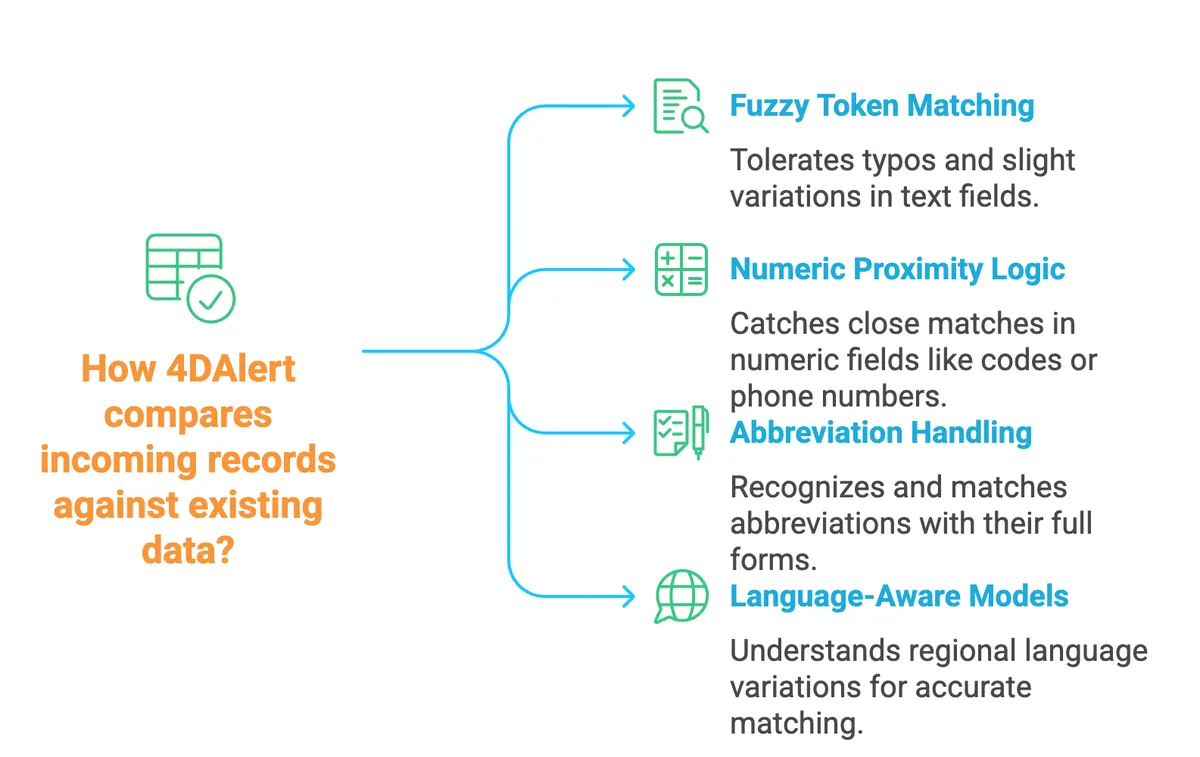
At this stage, 4DAlert’s MDM software compares records field by field instead of treating them as a whole. It applies fuzzy token matching for typo tolerance, numeric proximity logic to catch close matches in codes or phone numbers, abbreviation handling (like Pvt Ltd vs Private Limited), and, on top of that, language-aware models that understand regional variations.
Domain-Specific Intelligence
These comparisons aren't generic. They're trained on real-world enterprise data and tailored to your domain – whether that's suppliers, customers, products, or plants.
3. Weighted Composite Scoring
Here’s where things get interesting. Not every mismatch should carry the same weight. For example, two records with different email addresses might still be a match, but two with different Tax IDs? Probably not.
Weight Configuration Example
- Tax ID — High Priority
- Company Name — Medium Priority
- Email Address — Low Priority
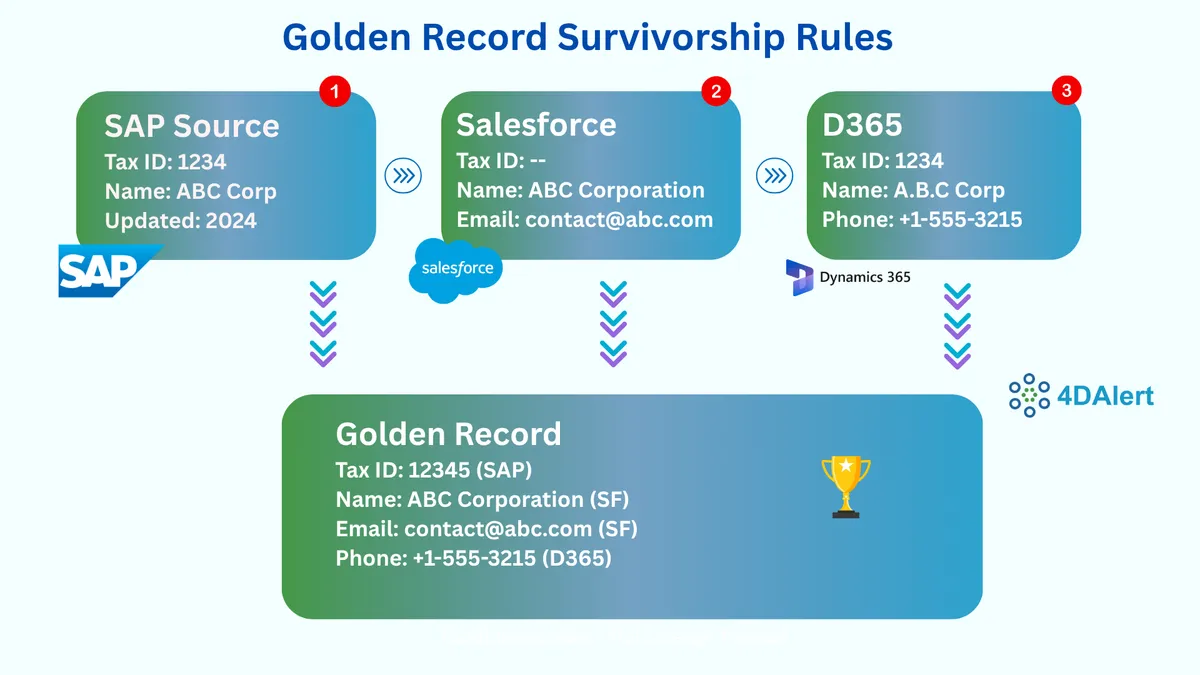
Configurable Thresholds: 4DAlert lets you configure attribute-level weights. You decide what matters most: Tax ID, Country, Plant Code, Phone Number — each can be dialed up or down. These weights roll up into a composite match score, helping you set clear thresholds for auto-match, review, or reject.
4. Record Grouping (Beyond Just Matching Pairs)
Most tools stop at finding record pairs that look alike. 4DAlert goes further by forming clusters of related records. Think of it as building a network graph of potential duplicates, where edges are match scores and nodes are incoming records.
Dynamic Evolution
As new data comes in, clusters evolve dynamically. You're not just identifying a duplicate — you're assembling the full picture of an entity that may exist in pieces across systems.
Why it matters:
This lets you reconcile not just a single match, but entire entity families
even across multiple systems.
It’s a powerful upgrade for customer master data management and other high-volume use cases.
5. Merge Engine with Survivorship & Golden Record Derivation
Once 4DAlert completes entity resolution and cluster assignment, it invokes its merge engine to synthesize a single golden record per entity cluster.
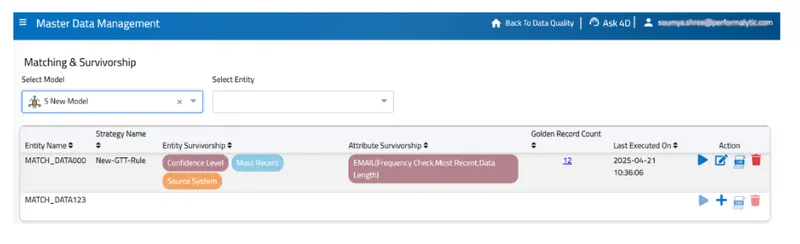
This isn’t just record stitching — it’s governed by configurable survivorship rules, including:
- Field-level recency scoring (most recently updated value)
- Source-system prioritization (based on predefined trust hierarchies)
- Flag-based validation (e.g., verified, approved, active)
- Data quality weighting (higher DQI wins in conflict resolution)
The result is a deterministic, auditable golden record where each field’s provenance is preserved. 4DAlert maintains full lineage — allowing users to trace which system and record version contributed to each attribute in the golden record.
Why it matters: You gain a high-trust, production-grade record that’s not only consolidated but fully explainable — critical for compliance, audit, and confidence in downstream use. It’s not just MDM — it’s explainable, high-trust master data you can rely on.
6. Continuous Learning with Data Quality Feedback and Reconciliation
Matching and merging are not one-time tasks — they’re continuous. That’s why 4DAlert’s AI-powered MDM software keeps learning from the data it processes through integrated and
Automated Data Quality (DQ), Data Reconciliation (DR), and Data Observabilityfeedback loops. As a result, smart alerts notify teams when match rules fail or confidence drops, creating a dynamic feedback cycle that keeps your MDM platform aligned with real-world business data.
👥 Human Override Learning
Captures stewardship decisions to refine fuzzy match boundaries
🔄 Reconciliation Tracking
Identifies frequent gaps and mismatched hierarchies
📈 DQ-based Scoring
Quality issues influence future matching confidence
🚨 Smart Alerts
Flags low-confidence or inconsistent results
Key capabilities include:
- Capturing human overrides during stewardship to refine fuzzy match boundaries and domain rules
- Tracking data reconciliation mismatches across systems to identify frequent gaps and mismatched hierarchies
- DQ-based scoring impact that are mismatches, nulls, and format issues influence future matching confidence and thresholds
- Smart alerts for when existing match rules produce low-confidence or inconsistent results.
These signals are logged, traced, and fed back into the matching logic over time and improving precision without requiring constant manual tuning.
Why it matters: Your match engine stays aligned with real-world data and business definitions and not just based on static rules, but from live reconciliation and quality feedback.
7. Entity Modeling to build stronger Master Records
Many MDM tools offer golden record outputs — but not all help you define what your master entities should even look like.
4DAlert includes a powerful Entity Modeling workbench that allows teams to define and design master entity structures from scratch — or generate them automatically from live databases.
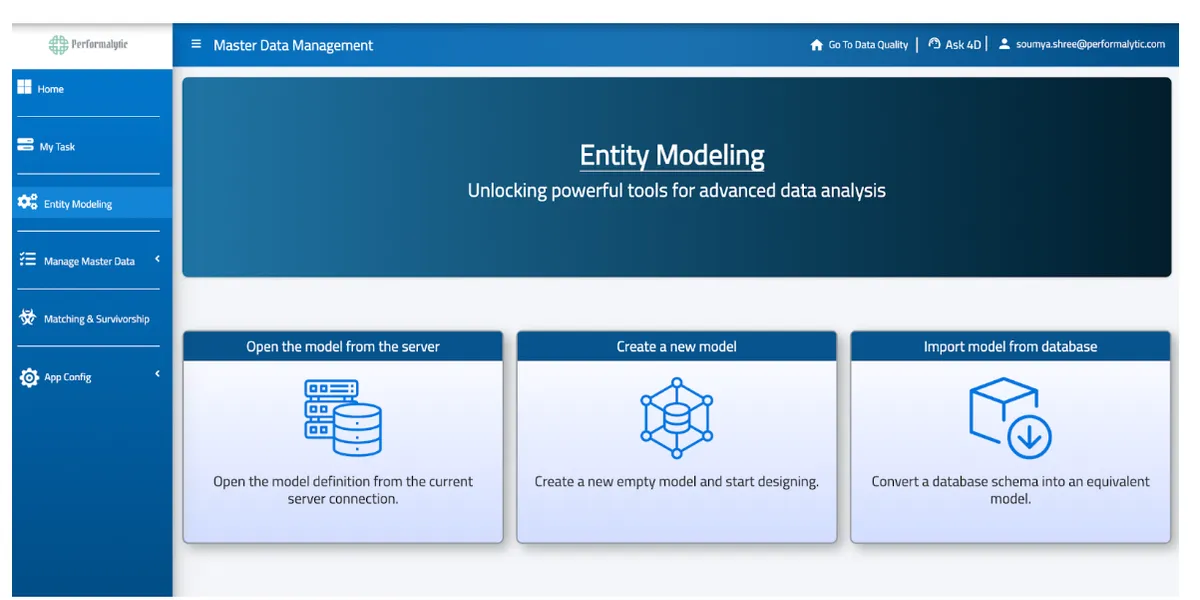
You can:
- Open models directly from your server: Instantly retrieve the current entity definitions connected to live data sources.
- Design a new model from scratch: Visually construct an entity model by defining attributes, types, and relationships — including support for custom metadata, validations, and mappings.
- Import from existing schemas: Convert your operational database schemas into structured entity models so that no manual rework is needed.
Smarter Matching with Stronger Master Data
4DAlert’s AI-driven matching engine goes beyond boosting match rates. It helps enterprises rethink their approach to MDM. By combining machine learning, business-specific logic, and continuous feedback from reconciliation and data quality metrics that fuel effective MDM, it delivers master data that’s not just clean — but trusted, explainable, and auditable.
Whether you’re managing product hierarchies across SAP, aligning customer records in Salesforce, or deploying a scalable master data management system, 4DAlert equips you with the confidence and control you need. Because matching isn’t just about finding similarities. It’s about creating master records that support real business decisions — and doing it at scale.
Discover how 4DAlert’s AI-powered MDM engine improves match accuracy, golden record creation, and data quality with continuous reconciliation across SAP, Salesforce, and more.
Get the 4DAlert Strategy Playbook
Where intelligent monitoring meets strategic execution.
- Assessment frameworks
- Best-practice strategies
- Implementation templates
Frequently Asked Questions
What is an AI-driven matching engine in MDM?
It is the component that decides whether records from different systems describe the same real-world entity. 4DAlert's engine pairs machine learning with configurable business logic, so it can resolve entities across systems such as SAP, Salesforce and Microsoft Dynamics 365.
Why are records normalized before matching?
Source systems store dates, currencies, units and casing differently. Normalizing them first means references like PLT-1101 and Plant 1101-AB can be recognized as the same plant instead of being treated as different values.
How does the match score work?
Each attribute has a weight, and the weighted results roll up into a composite match score. A mismatch on a critical attribute such as Tax ID can veto a match, while a difference in a minor one such as email cannot. Thresholds then decide whether a pair is auto-matched, sent for review or rejected.
What is an entity family?
An entity family is a cluster of records that all refer to the same entity. Clustering records as a family, rather than comparing isolated pairs, keeps related matches consistent before they are merged into one golden record.
Does the matching engine improve over time?
Yes. Steward overrides, reconciliation gaps and data quality scores feed back into match confidence, and smart alerts flag rules that return low-confidence results.
Can I trace a golden record back to its sources?
Yes. Merges are deterministic and the golden record keeps lineage to every contributing source system.