
AI-Powered MDM
AI in Master Data Management (MDM): 5 Ways Agentic AI Is Changing It in 2026
TL;DR
Key takeaways
- AI has moved MDM through three stages: decades of manual, rule-based stewardship, augmented AI that automates routine matching, and now agentic AI that monitors, investigates, plans and executes governed data operations
- Five shifts define agentic AI in MDM: relationship-aware entity resolution, context-aware data quality, root-cause reconciliation, natural-language data interaction, and agent-orchestrated database operations
- A $5B North American manufacturer found a best customer duplicated across 95+ systems; after putting AI agents on continuous entity resolution, it cut duplicate supplier records by 98% and saved $2.5M in procurement
- Choosing an AI-driven MDM platform means checking for native data quality and reconciliation, real connectors, transparent survivorship and lineage, proactive anomaly detection, natural-language access, and proven outcomes at scale
- Start small: pick one domain such as customers or suppliers, keep people in the loop for exceptions, and prove the value before expanding to the next entity
Gartner's often-cited estimate puts the average annual cost of poor data quality at $12.9 million per organization.
Data has never been more central to the business, or harder to trust. Customer, supplier and product records sit across ERPs, CRMs and cloud warehouses, and every mismatch slows decisions.
It matters even more now because of AI. AI models are only as reliable as the data they act on. If a customer exists twice, an AI will pick one record, or both, and answer with full confidence. A Golden Record, the single trusted version of a customer, supplier or product, gives AI a reliable input. Master data also lets AI connect those records, so cross-domain questions like "which suppliers concentrate risk in one region?" become answerable. For many organizations, the case for Master Data Management for AI readiness in 2026 is strong.
The link works both ways: AI is also changing how MDM itself works. This post looks at how AI master data management works, and how 4DAlert combines MDM, data quality and data reconciliation in one MDM platform.
What is AI-powered MDM?
AI-powered master data management uses machine learning and AI agents to match, clean and govern customer, supplier and product records across systems, creating a single trusted Golden Record without relying only on hand-written rules.
Why is traditional MDM failing in 2026?
Enterprises run on dozens of systems, from SAP and Salesforce to Snowflake and homegrown ERPs, and each one defines a customer, supplier or product in its own way. A customer appears as "Acme Corp" in the CRM and "Acme Corporation Ltd." in billing, supplier lists carry duplicates, and two departments report two different revenue figures.
The cost is real. Gartner's often-cited estimate puts the average annual cost of poor data quality at $12.9 million per organization. Traditional MDM set out to fix this, but it leans on hand-written matching rules and manual duplicate detection, separate quality tools and periodic batch clean-ups. Rules multiply with every new system and acquisition, and by the time a clean-up finishes, the data has already drifted.
How has AI in Master Data Management evolved?
AI has moved MDM through three stages, from manual upkeep to autonomous operations.
|
Stage |
How MDM works |
What changes |
|
Before: for decades, and as recently as 2023 |
Large steward teams, static rules, nightly or weekly batch matching, dashboards and work queues |
Reliable, but slow, reactive and costly |
|
2024: Augmented AI |
AI learns matching patterns, scores quality, flags anomalies, resolves records near-instantly and answers plain-language questions |
Routine decisions are automated; stewards handle edge cases |
|
Now: Agentic AI-powered MDM |
Goal-driven agents monitor, investigate, plan and execute governed data operations |
Moves from assisted decisions to controlled autonomous action |
These stages describe how the field is moving. No date is set for the agentic stage, so read "next" as the direction of travel, not a forecast.
Five ways Agentic AI is changing Master Data Management in 2026
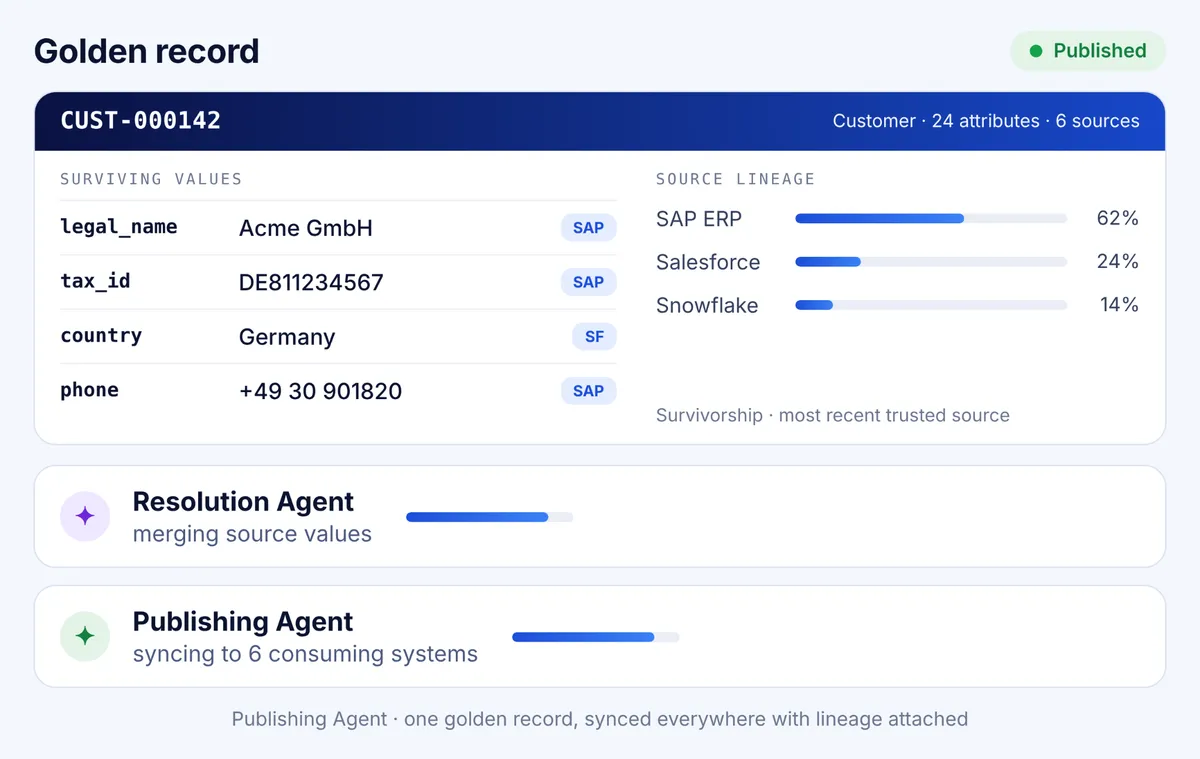
1. Entity Resolution Is Moving Beyond Attribute-Level Matching
Enterprise entity resolution is no longer just about finding records with similar names or matching identifiers. The real challenge is establishing relationships between entities when attributes conflict, source systems use different naming conventions, and business context changes over time.
AI-assisted matching can improve how organizations identify potential relationships, while survivorship rules determine which attributes contribute to the authoritative record.
4DAlert approaches this through AI-powered MDM and entity resolution, helping organizations consolidate fragmented entity records through AI-powered duplicate detection and establish Golden Records across disconnected enterprise systems. The objective is not simply to eliminate duplicates, but to create a reliable entity foundation for downstream business operations.
2. Data Quality Is Becoming Context-Aware
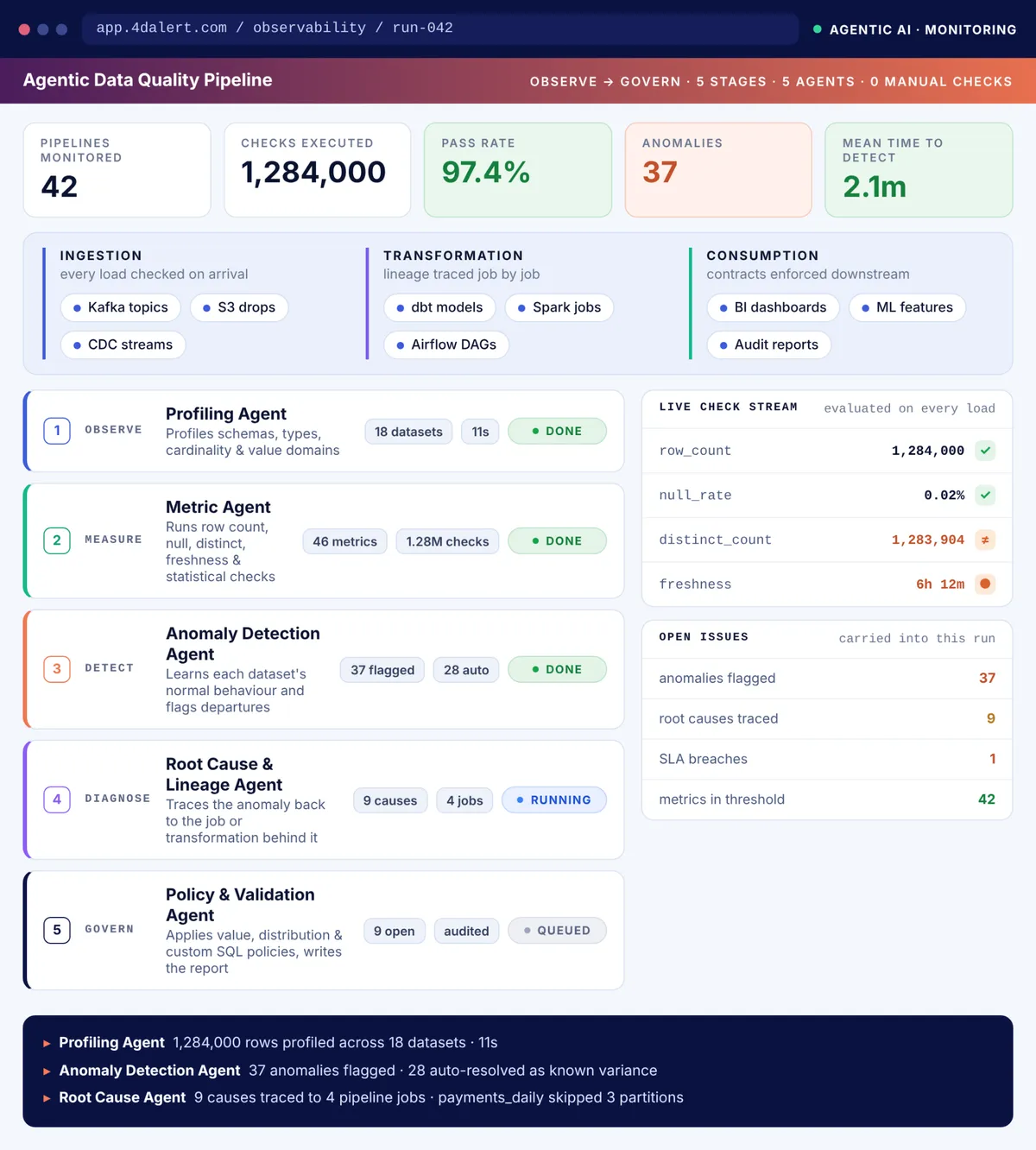
A record can pass every predefined validation rule and still be wrong for the business process consuming it. This is where conventional data quality approaches reach their limits. Organizations need to understand not only whether data meets technical thresholds, but also whether changes in its structure, distribution, and business context affect its reliability.
AI-driven quality intelligence can help identify deviations that conventional validation rules may overlook. Combined with continuous data observability, this creates a more dynamic approach to data trust.
4DAlert brings Data Quality and Data Observability together to track quality conditions, identify anomalies, and investigate changes across enterprise data environments. This is particularly important as organizations prepare AI-ready data for analytics and AI-driven workloads.
3. Reconciliation Is Evolving into Data-Level Root-Cause Analysis
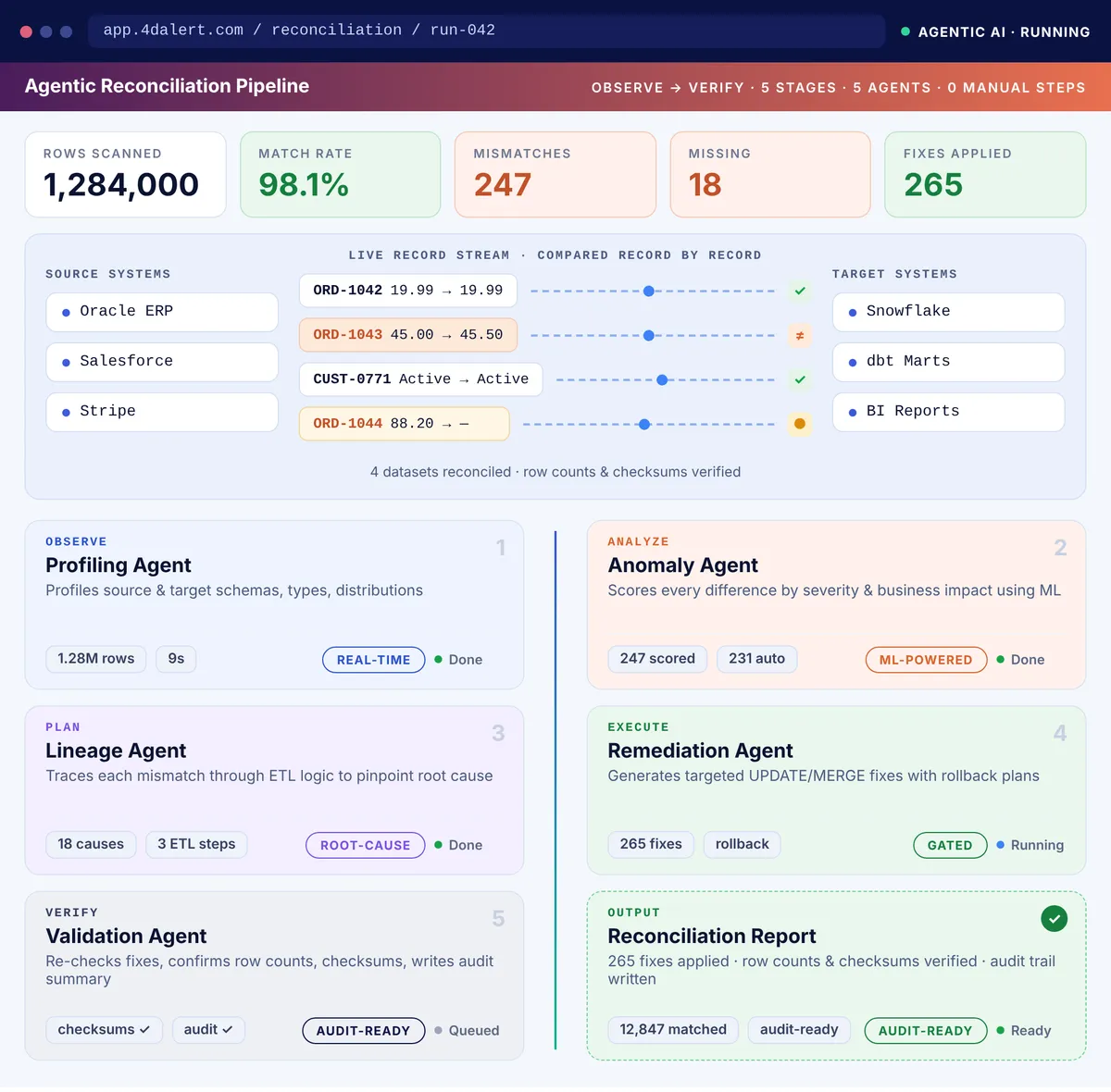
When financial figures differ between operational systems and analytical platforms, comparing totals is rarely enough. Teams need to isolate mismatches at record and column levels, identify affected business segments, and understand which upstream changes introduced the discrepancy.
This is where AI-assisted investigation can complement deterministic data reconciliation. Rather than replacing comparison logic, intelligent investigation can help teams navigate exceptions and prioritize the underlying causes.
4DAlert combines automated source-to-target data reconciliation with mismatch analysis, segment-level investigation, run history, and audit visibility. This gives data teams a structured way to move from identifying discrepancies to understanding their operational impact.
4. Enterprise Data Interaction Is Shifting from SQL Dependency to Contextual Reasoning
The challenge with enterprise data is not always a lack of information. It is the time and technical expertise required to retrieve the right information from complex data environments.
Generative AI enables natural language to SQL, where users express business questions in plain English and get data queries back. The next level is contextual reasoning, where answers can draw on enterprise metadata, data lineage, and available data quality information.
4DAlert's Ask4D brings this interaction directly into its enterprise data management environment. Users can generate SQL, explore metadata and data lineage, and investigate data-related questions without relying entirely on manual query development.
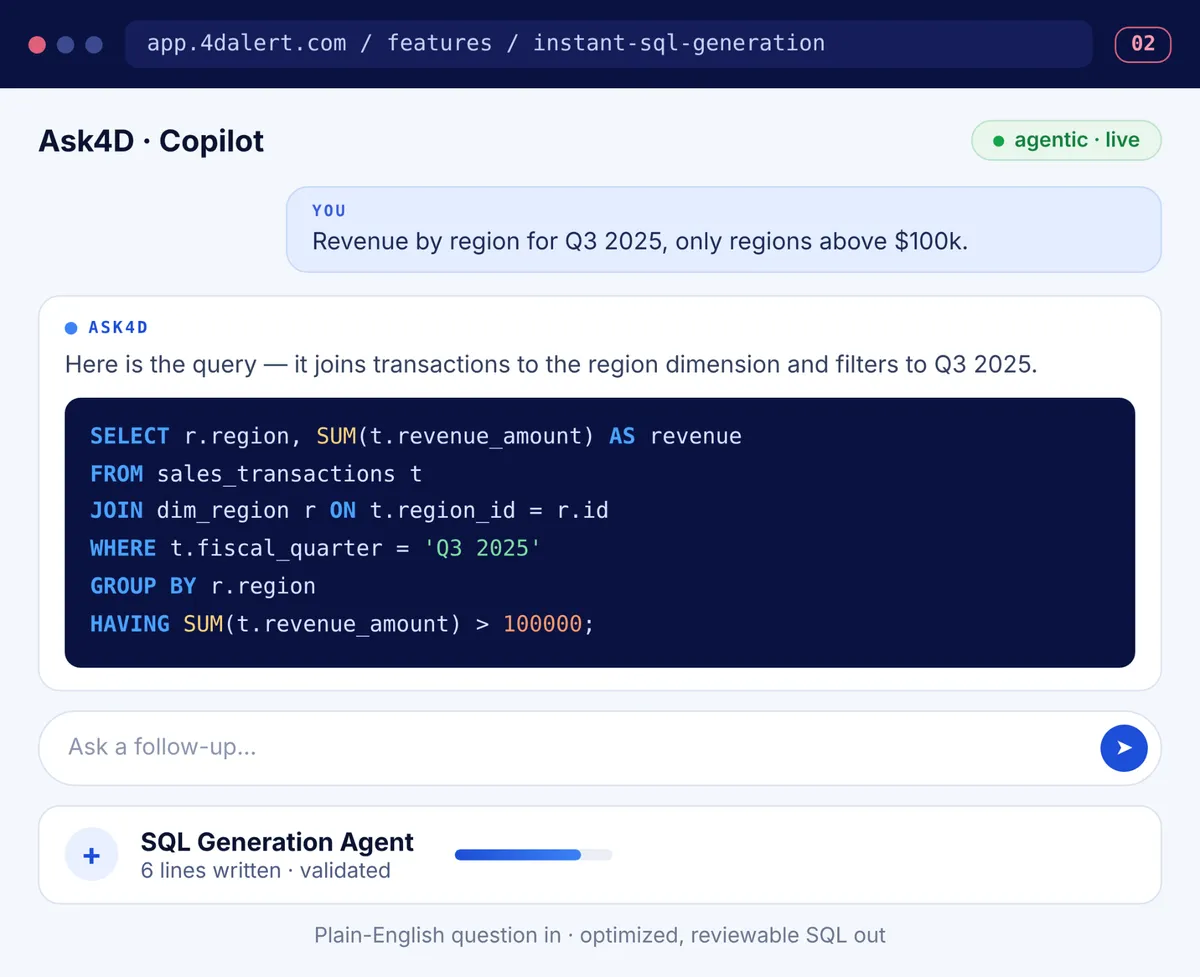
For example, ask "List all customers in North America with total revenue above $100,000 for fiscal 2025" and Ask4D returns the SQL with a plain-English explanation. Then ask "Why don't these revenue figures match between our ERP and CRM?" and it helps you trace the source-system differences. In our deployments, Ask4D has reduced time-to-insight by nearly 75%.
5. Database and Data Operations Are Moving Toward Agent-Orchestrated Execution
The next challenge for enterprise data management is coordinating actions across systems rather than automating isolated tasks. Consider a supplier data change that introduces schema inconsistencies, affects downstream mappings, and creates reconciliation exceptions. Resolving the issue requires more than a notification. It requires understanding dependencies, assessing impact, coordinating corrective workflows, and verifying the result.
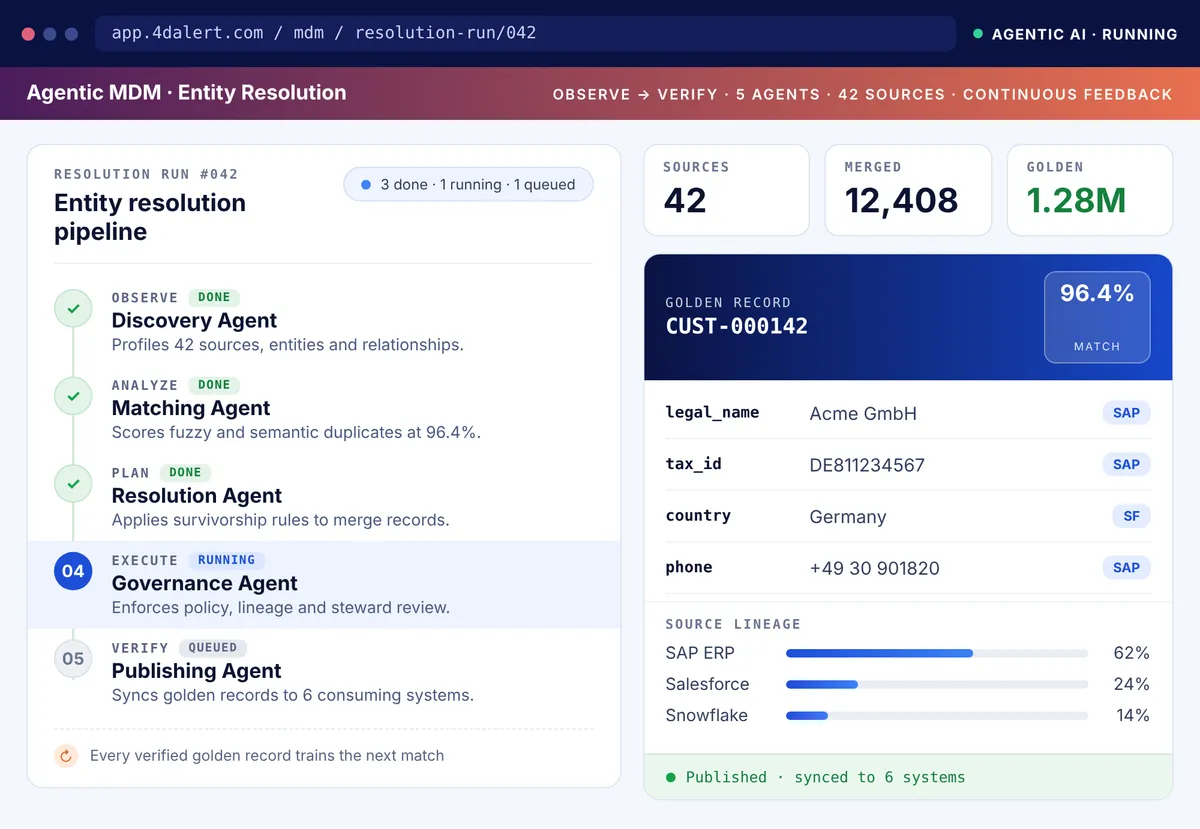
Agentic AI MDM introduces the possibility of specialized agents handling these connected stages. An orchestration layer can coordinate detection, investigation, planning, execution, and verification, while data governance policies determine which actions require approval.
This is the direction of 4DAlert's Agentic AI approach: connecting enterprise data intelligence with coordinated operational workflows across MDM, reconciliation, data quality, observability, and database operations. The focus is on moving from isolated automation toward context-aware execution with traceability and human oversight.
Case study: is your best customer in your system twice?
If your company runs on a lot of systems, there's a good chance you're treating one customer like two.
That's what happened at a $5B North American manufacturer. Their customer, supplier, and product data sat across 95+ ERP and source systems. One customer was there under two different identities. Under one, they were paying $3 million a year for services. On the other hand, nobody in sales knew about it.
So nobody offered them a $1M annual maintenance contract. The customer was already there. The deal just never got pitched.
Nobody dropped the ball. Each team was working with the data it could see. And no team can match records across 95+ systems by hand and keep up.
So they put AI agents on it
The manufacturer used 4DAlert AI-powered MDM. Instead of a one-time cleanup, AI agents kept going through the records every day. They found customers and suppliers that were the same entity even when the names didn't match, and suggested merges for the data team to approve. When a new duplicate showed up, they caught it early.
A cleanup project is finished the day it ends. The agents don't stop.
Here's what it led to:
- 98% fewer duplicate supplier records
- 40% faster supplier onboarding
- 12% cross-sell revenue growth
- $2.5M in procurement savings, plus $1.1M in extra supplier discounts
- $3M less inventory overstock
How to choose an AI-driven MDM platform
Not every platform that claims AI delivers it where it matters. When evaluating options, ask:
- Is data quality native? Automated Data Quality, Data Reconciliation and Data Observability should be part of the platform, not separate tools you integrate later.
- Does it connect to your real landscape? Look for prebuilt connectors and flexible APIs across ERPs, CRMs and cloud warehouses.
- Is the AI transparent? Survivorship rules, data lineage, access control and audit trails should show why a Golden Record looks the way it does.
- Is it proactive? Anomaly detection and real-time alerts matter more than another dashboard.
- Can business users self-serve? Natural language access determines whether adoption stays with the data team or spreads across the company.
- Is it proven at scale? Ask for measurable outcomes and how quickly they arrived.
Our MDM Strategy Playbook includes a free maturity assessment and ROI calculator.
Where to start: small, visible, low-risk
You do not need a full transformation on day one. KPMG recommends starting where value is visible and risk is low, adding guardrails and feedback loops, and scaling what works. Good first use cases include AI-assisted duplicate detection, product classification, automated data quality monitoring, predictive quality scoring and natural language search over your data catalog. A focused pilot on one domain, such as customers or suppliers, builds confidence and proof of value before you expand.
Final thoughts: Where AI and MDM go from here
MDM used to be a background governance project. In 2026, it decides whether your analytics, compliance work and AI projects can be trusted. AI is what makes it keep up: it matches records across systems, catches quality problems early, traces mismatches to their source and lets business users ask questions without waiting on an engineer.
The manufacturer in our case study didn't start with a full transformation. They put AI on one messy problem, duplicate customers and suppliers, and the results followed. You can do the same: pick one domain, keep people in the loop for exceptions, and prove the value before you expand. To see how master data supports governance in practice, read MDM and Data Governance: How Master Data Management Makes Governance Work.
If your teams still debate whose numbers are right, it may be time to see what a unified, AI-powered approach can do with your own data. Book a demo with 4DAlert or explore the 4DAlert platform.
Frequently Asked Questions
What is agentic AI in master data management?
Agentic AI in MDM uses goal-driven AI agents that monitor data, investigate issues, plan fixes and carry out governed data operations. Humans approve exceptions and high-impact actions. It goes beyond assisted AI, which only suggests matches or flags problems, toward controlled autonomous action.
How does AI improve entity resolution?
AI learns matching patterns across records, so it can identify the same customer or supplier even when names, formats or identifiers differ, such as "Acme Corp" and "Acme Corporation Ltd." It scores match confidence, suggests merges for review, and reduces the hand-written rules traditional MDM depends on.
What is a Golden Record?
A Golden Record is the single, trusted version of a customer, supplier or product, built by consolidating records from multiple systems. Survivorship rules decide which attribute values win. It gives analytics, compliance and AI models one reliable source instead of conflicting duplicates.
What is the difference between MDM and data quality?
MDM creates and maintains the trusted master record for core entities such as customers, suppliers and products. Data quality checks whether data is accurate, complete, consistent and timely. They work best together: quality monitoring keeps master data clean, and MDM gives quality rules one consistent record to measure.
How do you make data AI-ready?
Start by consolidating duplicates into Golden Records, then monitor data quality and observability continuously, track data lineage, and apply governance and access controls. AI-ready data is accurate, consistent, explainable and traceable, so models and agents act on one trusted version of each record.
What should I look for in an MDM platform?
Look for native data quality, reconciliation and observability, prebuilt connectors to your ERPs, CRMs and warehouses, transparent survivorship rules and lineage, proactive anomaly alerts, and natural language access for business users. Also ask for measurable outcomes at scale and how quickly customers saw results.